

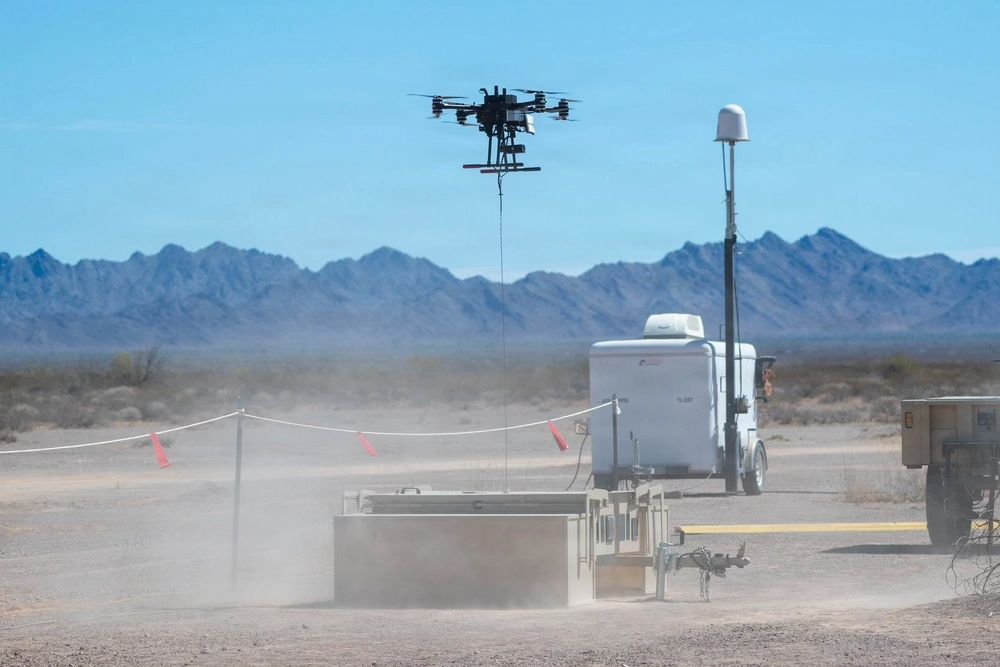
When we talk about drone operations, we usually assume the aircraft needs to fly far from its controller, whether to follow a preset path or to trace the source of a problem. That isn't always the case. Sometimes a drone needs to hover in one place for a very long time, and that is where tethered drones shine.
The tether technology itself is advancing quickly. One company excelling in the niche is Linden Photonics, who’s new MicroTethers earned the Commercial UAV Expo Innovation Spotlight in the Propulsion, Power & Energy category this year.
A MicroTether is a thin, lightweight cable connecting a drone to equipment on the ground. In the hybrid version featured in the Innovation Spotlight, copper conductors deliver electrical power while optical fiber carries data, such as video and control communications, through the same cable.
Persistence is the Point
The main benefit of a tethered operation is persistence. Stanya Komarkova, business development manager at Linden Photonics, explained to Commercial UAV News what that means in practice. Tethered drones can provide hours of aerial service from a single position without landing to change a battery.
"That changes the job the aircraft can do: instead of collecting occasional snapshots, it can provide an ongoing view or communications point," Komarkova said.
That may sound like a job for a fixed camera or a conventional drone, but the tether offers advantages over both. "A tethered drone can put a camera above an event or incident without building a permanent structure, and the team can move the ground station when the area of interest changes. It can hold that viewpoint longer than a battery-powered drone typically can without a rotation plan," they explained.
Komarkova pointed to one real-world example of endurance: a customer kept a tethered quadcopter airborne for 100 continuous hours for fire detection. A battery-powered aircraft would have needed repeated landings or a rotation of replacement aircraft to maintain the same watch.
Mobility and durability also make tethered drones useful in disasters and severe weather. "Imagine an environmental disaster like a tornado where someone wants to set up a temporary workspace, but they won't be there long term. In this situation, they can use a tethered drone as a temporary tower, and it is much less expensive than erecting a tower and vastly quicker to deploy," Komarkova said.
Why Combine Power and Data?
Some aircraft need both power and a data link, and combining them gives the operator one tether to deploy, manage, and retrieve instead of two separate lines that could move and snag independently.
Fiber also offers an advantage over wireless. Data traveling through fiber doesn't compete for radio spectrum between the aircraft and the ground station, which matters when channels are congested or deliberately disrupted, especially for continuous video. For law enforcement or military users, a fiber link also means no one other than the operator can communicate with the drone.
What Deployment Looks Like
The crew sets up a ground station with a power source, a tether reel, and equipment that handles data. The tether runs from that station to the aircraft. Power travels up the copper conductors, usually through conversion equipment matched to the aircraft, while camera data and other signals travel over the fiber back to the ground. From there, the data can reach a local operator or a wider network if the ground station is connected to one.
Controlled Operations
The idea of a tethered drone isn't novel, but Linden Photonics set out to make the cable light enough that operators don't have to sacrifice payload. "We developed MicroTethers to give system builders a cable they can size for the aircraft, the required power, and the operating conditions," Komarkova said. "Some small drones and aerostats need power and communications to remain in the air indefinitely. They cannot carry a cable so heavy or bulky that they need to sacrifice payload."
Because the aircraft operates within a range set by its anchor point and deployed cable, and the ground crew can manage the tether during launch, flight, and recovery, tethered systems suit customers who need an aircraft to hold a defined position. That includes law enforcement and defense users. Some customers have also used tethered drones near airports, where the FAA tends to be more accepting of them. Their altitude and range are limited by design, so they can't stray into a flight path or restricted airspace.
The Impact
According to Komarkova, MicroTethers and tethered systems are unlocking capabilities previously limited by batteries, wireless bandwidth, or physical constraints:
- Turning short-duration drones into persistent systems
- Enabling reliable, high-bandwidth connectivity anywhere
- Making aerial security and monitoring continuous, with real-time HD video over fiber, safer controlled operations, and lower labor costs, inspection times, and operational risk
Whether the payload is a security camera, a communications radio, or a research sensor, the underlying need is the same: keep useful equipment in the air while supplying power and bringing data back down. MicroTethers address the cable side of that challenge in a compact design that can be tailored to the platform.
The Biggest Misconception
Many people don't realize how limited a typical battery-powered drone's flight time is, and Komarkova says that leads to the biggest misconception: that a tether is just a leash on an ordinary drone. It does limit where the aircraft can fly, but it also lets the operator use the aircraft differently, as a sustained observation or communications point. The cable is "smart," transmitting power and bidirectional data while also serving as a strengthened tether. It has to be carefully engineered for weight, strength, flexibility, environmental conditions, and deployment.






Comments