
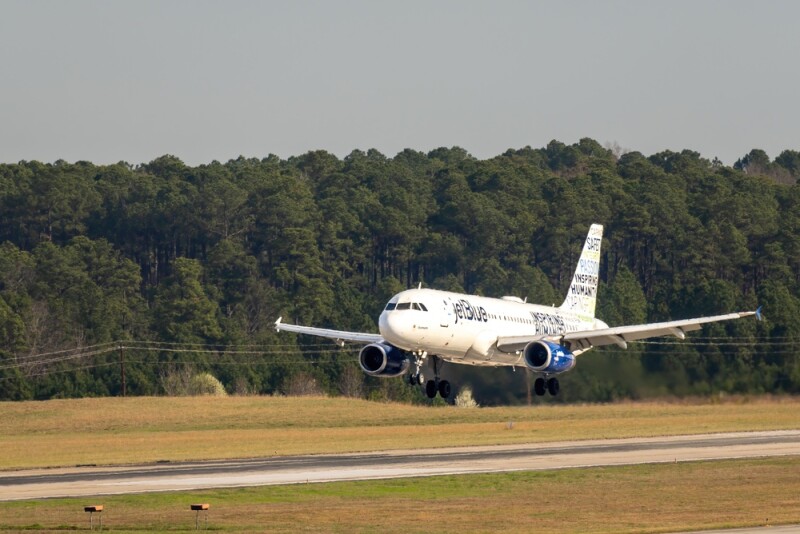
When a JetBlue crew reported striking a drone on final approach into New York’s JFK Airport, the claim immediately drew attention. Drone‑aircraft mid-air collisions are amongst the most sensitive topics in modern aviation, and any suggestion of an impact, especially at low altitude during a critical phase of flight, tends to ripple quickly through industry channels. Yet as investigators worked through the details, the event evolved from a dramatic headline into a far more familiar story: a pilot reported an object, the aircraft landed safely, and no evidence of a drone was ever found.
The flight in question, JetBlue 948 from Las Vegas, was descending through roughly 3,000 feet when the pilot informed air traffic control that the aircraft had “collided with a drone” above the cockpit. The crew continued the approach without difficulty and landed at 7:21 a.m. Within minutes, maintenance personnel began a standard post‑event inspection, an essential step whenever a flight crew reports a possible strike with any airborne object.
That inspection revealed first the most important fact: The Airbus A321 showed no damage whatsoever. No dents, no scratches, no paint transfer, no residue, and no structural marks consistent with a collision. With no physical evidence to support the report, the aircraft was returned to service shortly thereafter.
The FAA reviewed radar data, local drone activity records, and other operational information. Nothing indicated a drone operating in the area at the time of the report, and no witnesses or secondary sources corroborated the presence of an unmanned aircraft. In short, the investigative picture aligned with what aviation safety analysts have repeatedly seen over the past decade: pilots occasionally encounter birds, balloons, or even optical illusions that can appear, momentarily, like drones, especially during high‑workload phases of flight.
The airspace surrounding New York City is considered to be one of the most congested in the world, and every landing is a study in human concentration and extremely coordinated crew resource management in which the separation between planes to land or depart from the four major airports in the area is a well-orchestrated dance that leaves very little room for error.
Because the aircraft sustained no damage, no injuries occurred, and no confirmed object was involved, the event did not meet the threshold for a National Transportation Safety Board (NTSB) investigation. The NTSB’s mandate is clear: It investigates accidents and significant incidents involving substantial aircraft damage, serious injuries, or major safety implications. A reported strike with no evidence and no impact on the aircraft’s airworthiness does not qualify. As a result, no preliminary NTSB report exists for this case.
JetBlue, for its part, followed standard procedure. The crew reported the event, the aircraft was inspected, and the company deferred to FAA investigators for further review. Their internal conclusion mirrors the FAA’s early findings: There is no proof of a drone, and the aircraft was never compromised.
Commercial UAV News reached out to JetBlue for official comment, but at the time of this publication, we have not yet received a response.
The incident ultimately serves as a reminder of how aviation safety systems are designed to respond: Crews report what they see or what they think they saw; investigators examine the evidence, and conclusions are based on facts rather than assumptions. In this case, the facts point to a simple outcome: a safe landing, an undamaged aircraft, and a drone strike that almost certainly never occurred.
The JetBlue “drone strike” that never was offers a revealing look at how aviation incidents are treated in the modern news cycle. It is a pattern familiar to anyone who works in airspace safety: dramatic claims receive immediate, front‑page attention, while the quieter, fact‑based resolution arrives later, if it arrives at all.
When JetBlue Flight 948 reported a possible drone collision on final approach to JFK, the story had all the ingredients of a headline‑grabber. A commercial airliner, a crowded airspace, and a pilot’s urgent radio call created a narrative that practically wrote itself. Within hours, major outlets published stories with language that suggested a serious breach of airspace safety. Social media amplified the drama, often stripping away nuance and presenting the report as confirmed fact.
But aviation investigations run on evidence, not adrenaline, and the evidence in this case was unequivocal. The aircraft landed safely. The post‑event inspection found no damage, no residue, and no physical signs of a collision. FAA data showed no drone activity in the area. With no corroboration, the report remained a pilot’s perception during a high‑workload moment, not a verified strike.
This is where the media narrative diverges from the investigative one. The initial claim, urgent, visual, and easy to summarize, gets prominent placement. The resolution, technical, uneventful, and lacking drama, rarely earns the same attention. Only a few outlets published follow‑ups noting the absence of evidence. Many never updated their original stories at all.
The result is a public perception shaped disproportionately by the first wave of reporting. The ‘front page’ moment lingers, while the ‘page 13’ correction quietly slips into the background. For drone policy, aviation safety, and public understanding of risk, this imbalance matters. It reinforces the idea that drone strikes are common when, in reality, confirmed collisions are extraordinarily rare.
The JetBlue case is a textbook example that the press gravitates toward the dramatic and the large font claim, but the truth, methodical, evidence‑based, often mundane and small font, arrives later, long after the headlines have moved on.
The problem is that public perception persists that these pesky drones are everywhere and interfering with traditional aviation operations, when the truth is nowhere near that nonsense.
Why Confirmed Drone Strikes in U.S. Airspace Are So Rare
Despite thousands of pilot reports of drone sightings over the past decade, confirmed drone strikes involving U.S. commercial aircraft remain extraordinarily rare. In fact, across all FAA and NTSB records, only a handful of cases have ever been conclusively verified, including a 2017 incident in which a DJI Phantom struck a U.S. Army Black Hawk helicopter over Staten Island and the famous mid-air collision between a photogrammetry drone and a Robinson helicopter in the vicinity of the Daytona Beach International Airport (KDAB) at the end of 2023.
Both crewed aircraft sustained minor damage. In the first case, investigators recovered drone fragments and matched them to a specific operator. In the second, the drone was flying legally but outside its Certificate of Authorization (COA) guidelines. That level of physical evidence is what distinguishes confirmed cases from the far larger pool of unverified reports.
The FAA receives 1,500–2,000 drone sighting reports per year, but the vast majority fall into three categories:
- No object found after landing and inspection.
- Birds or balloons misidentified as drones.
- Optical illusions created by reflections, shadows, or converging traffic patterns.
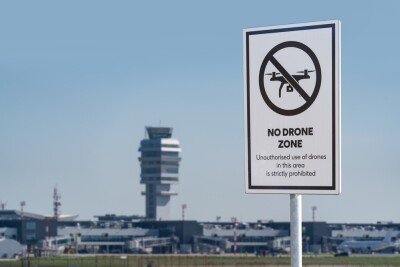
Image: Shutterstock
Commercial pilots operate 90 percent of the time looking at instruments in their cockpits following Instrument Flight Rules, and only 10 percent in complex visual environments, especially during takeoff, approach, and landing. A small bird passing close to the windshield at 150 knots can appear momentarily like a quadcopter. Balloons, particularly metallic party balloons, are a frequent culprit. And in several well‑documented cases, pilots have reported “drone-like” objects that were later identified as model aircraft flying legally at designated AMA fields.
The FAA and NTSB rely on strict criteria before classifying an event as a drone strike. Investigators look for:
- Physical evidence (debris, residue, paint transfer).
- Aircraft damage consistent with a collision.
- Radar or telemetry data showing a drone in the vicinity.
- Witness corroboration, when available.
- Operator identification, when possible.
Without these elements, a report remains just that, a report. This is why events like the recent JetBlue case do not escalate to NTSB involvement. With no damage, no debris, and no confirmed drone activity, the incident does not meet the threshold for a federal accident or incident investigation.
The rarity of confirmed strikes reflects the layered protections built into the national airspace system: geofencing on consumer drones, FAA regulations restricting unmanned aircraft near airports, and increasing adoption of Remote ID technology. While pilot reports are taken seriously, the investigative record shows that actual collisions are exceedingly uncommon, and most sightings represent either misidentifications or non‑hazardous encounters.
For aviation safety professionals, this distinction matters. It ensures that resources are focused on genuine risks rather than anecdotal reports, and it reinforces a data‑driven understanding of how drones interact with the airspace. In the United States, the evidence continues to point to the same conclusion: drone sightings are common, but verified drone strikes are almost nonexistent for now. The issuance of Part 108 might change this, as thousands of drones flying beyond the operator's visual range will have to depend on highly automated systems to keep them away from airports and areas where helicopters or agricultural aircraft operate. Let’s all work together to ensure the new ruling does not significantly increase this statistic.










Comments