

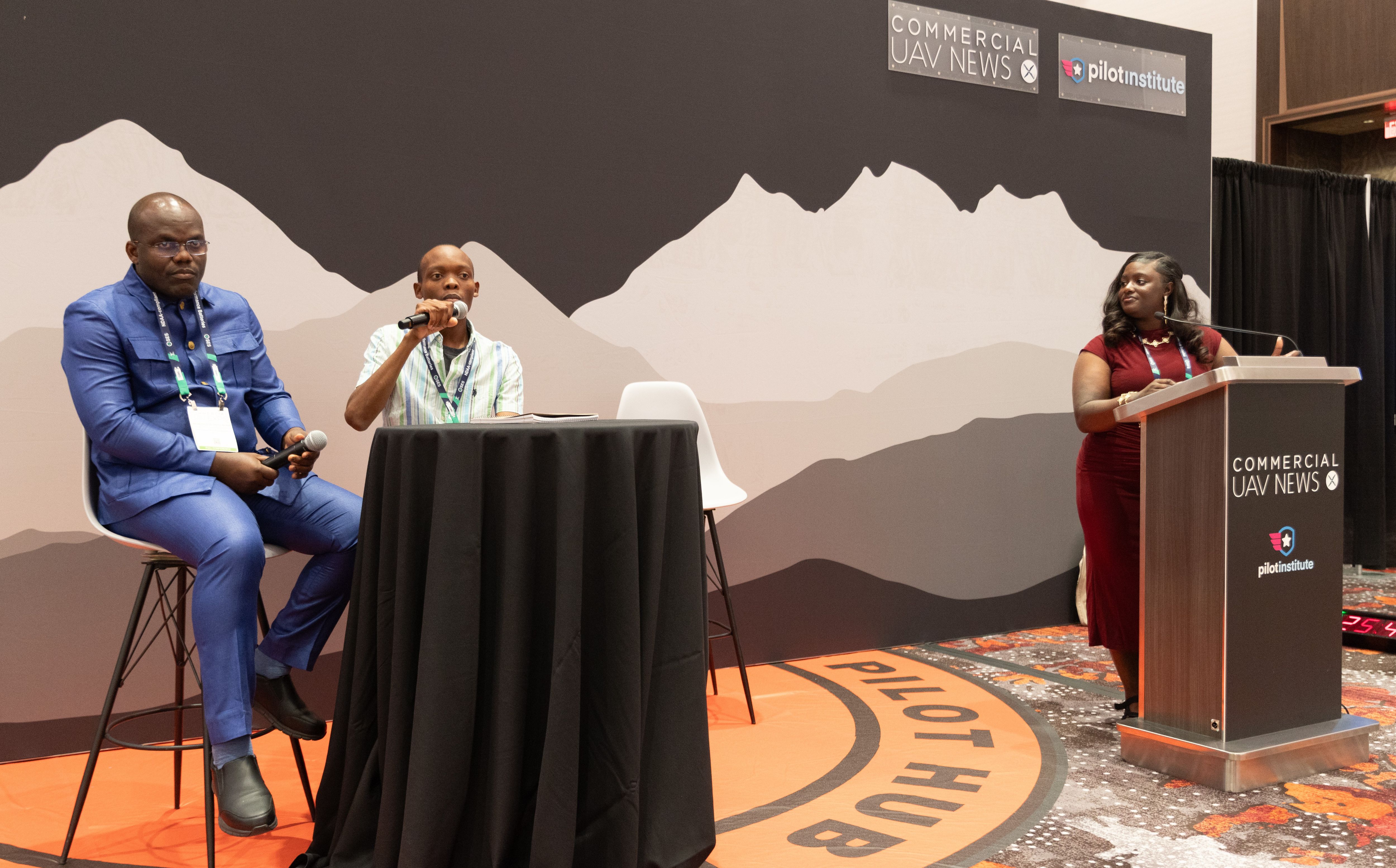
Commercial UAV Expo once again opened its doors to newcomers this year with the UAV Empower Path to Leadership Event Scholarship, now in its second year and sponsored by CubePilot and NW Blue. The program gives people just entering the commercial drone industry a chance to tell their stories and earn a spot at the show, where they can meet working professionals and learn how the industry really operates. It’s one piece of the broader CUAV Empower initiative, which works to advance diversity, equity, and inclusion in the field. Recipients are chosen for their commitment to moving the industry forward while also bringing others along with them.
Scholarship winner Tatenda Gondo is making strides towards building an autonomous crop-spraying drone that utilizes swarming technology to advance innovation in agriculture. Today, he is gaining valuable experience as a ground support operator and visual observer for Wing. Commercial UAV News spoke with Gondo to learn more about his goals.
Commercial UAV News: How will you use your UAV Empower: Path to Leadership Event Scholarship? What are the next steps you are planning in your career and education?
Tatenda Gondo: As a green card holder and immigrant, receiving this scholarship has served as powerful validation of the path I have chosen and the progress I have already made. It has strengthened my confidence to set higher goals and pursue them with greater determination. I was recently inducted into the National Society of Leadership and Success (NSLS) through a nomination from my school, which has further reinforced my commitment to personal and professional growth.
In the near term, I am preparing to apply for a summer 2027 internship with Wing as either a Flight Test Engineering Intern or a Manufacturing Engineering Intern. I plan to graduate in December 2027, and securing relevant industry experience before then is a top priority.
I also intend to stay in touch with the contacts I made with companies that were exhibiting at the UAV Commercial Expo 2026. By maintaining these relationships, I can explore ways to make myself useful to their teams, learn about the exciting new projects they are working on, and identify opportunities to contribute my skills or gain further experience. This proactive networking will help me stay informed about industry developments and open doors beyond formal internship applications.
Looking further ahead, within the next two to three years I intend to actively pitch my business idea for an autonomous agricultural drone. Once I have saved enough capital to develop a working prototype, I will focus on refining the concept, seeking feedback from industry partners, and exploring opportunities to bring the system to market. The scholarship would help cover educational and professional development costs, allowing me to concentrate on these goals without added financial pressure.
CUAVN: Can you share a little about any current projects you are working on?
TG: I am currently contracted through Qualrec and Randstad to support Wing as a Ground Support Operator and Visual Observer. This role allows me to gain hands-on operational experience with commercial drone operations while I prepare for a formal summer internship. Working on active missions has given me a clearer understanding of the practical challenges involved in safe, efficient, and scalable uncrewed systems operations.
Outside of work, I am independently designing an autonomous crop-spraying drone that incorporates swarm technology. The idea is still in the conceptual and early design stage; I am researching relevant sensors, control systems, and regulatory requirements while planning how the swarm would coordinate spraying tasks efficiently and safely. My goal is to move from design to a physical prototype once I have accumulated sufficient savings. This personal project is closely aligned with the agricultural drone business idea I hope to develop after graduation.
CUAVN: Who has inspired and encouraged you as you have pursued work in drones? What have you learned from your teachers and mentors?
TG: My first instructor in my master’s program, Professor Nicole Bier at Embry-Riddle Aeronautical University, played a foundational role in my transition into uncrewed and autonomous systems. Coming from a background in geography and environmental science, I needed guidance on how to build new technical and research skills. She taught me how to use the university’s e-library effectively, how to identify key search terms to stay current with industry literature, and why continuous learning through refresher courses and professional certifications matters alongside a formal degree. Her emphasis on remaining relevant in a rapidly evolving field has shaped how I approach both my studies and my career planning.
The team I work with through Randstad and Wing has been equally influential. They have shown me how to refine operational procedures, maintain high standards of safety and precision, and build confidence in a professional setting. They also encouraged me to share my personal story as an immigrant within the company. The positive responses I received, especially from colleagues who had similar backgrounds and had advanced to senior roles, reinforced that my experiences are valuable and that persistence is recognized.
Most recently, my involvement with the National Society of Leadership and Success has inspired me on a different level. Although Oprah Winfrey is not involved in drones, her messages about commitment, resilience, and personal growth, shared through NSLS speaker broadcasts, have motivated me to approach my long-term goal of building an agricultural drone with greater discipline and spiritual grounding. Together, these mentors and experiences have taught me that technical skills, continuous learning, professional mentorship, and personal resilience all contribute to success in this field.
CUAVN: Looking ahead, what do you hope to be doing in one year or five years? Do you think you will still be working with drones?
TG: Securing full-time employment in the drone industry is my immediate priority after graduation. In one year, I hope to be working in a technical role, ideally related to flight testing or manufacturing engineering, where I can continue building practical experience while completing my degree.
In five years, I still expect to be deeply involved with drones. I see myself advancing the design and development of my own autonomous agricultural drone, with a focus on flight testing and manufacturing engineering. My longer-term vision is to operate independently while also forming partnerships with larger corporations that can help scale production, distribution, or regulatory support. Whether through employment, entrepreneurship, or a combination of both, I am committed to remaining in the uncrewed systems industry and contributing to practical applications such as precision agriculture.


.jpg.small.400x400.jpg)


Comments