
This article is part one in a two-part story looking at the role test sites are playing in the UAS industry from both a technological and regulatory standpoint.
Integrating UAS into the National Airspace System (NAS) presents one of the most complex technological challenges facing aviation today. Aircraft operating without pilots on board must detect other traffic, maintain reliable communications, respond to unexpected situations, and function safely across increasingly demanding operating environments.
Much of the technology required to accomplish these objectives already exists. The challenge is demonstrating that individual components can work together consistently, under real operating conditions, and with the reliability expected of aviation systems.
Distributed across the United States, these facilities provide the airspace, infrastructure, technical expertise, and operational environments needed to evaluate technologies that could eventually enable routine BVLOS operations.
Their geographic diversity is particularly important. Testing an aircraft over North Dakota's open plains presents different challenges from operating in Alaska's extreme weather, Nevada's mountainous terrain, or the more populated environments of New York.
Building the Infrastructure for Advanced Flight Testing
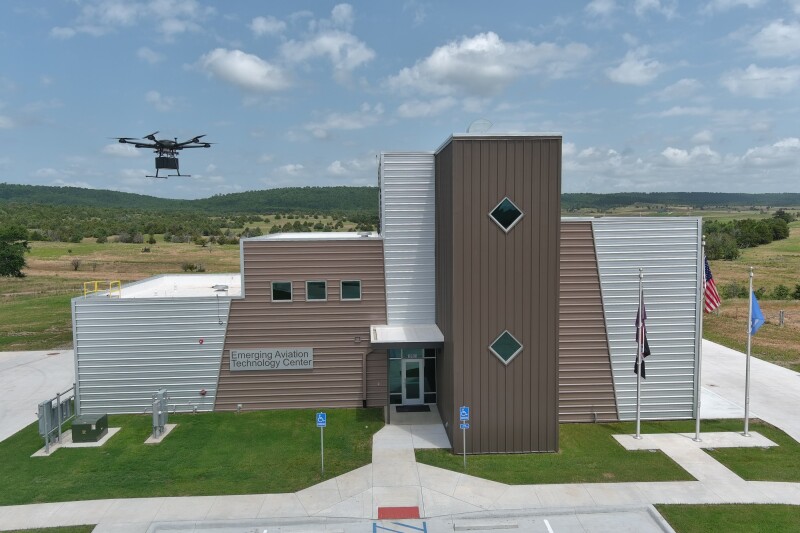
Testing uncrewed aircraft requires sophisticated ground infrastructure, surveillance equipment, communication networks, specialized sensors, and engineers who can measure and analyze flight performance. At the Choctaw Nation of Oklahoma's Emerging Aviation Technology Center, a dedicated testing area covers a considerable amount of land and supports these capabilities.
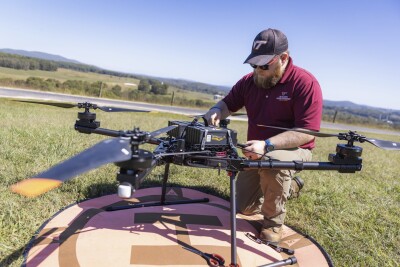
James L. Grimsley, Executive Director of Advanced Technology Initiatives for the Choctaw Nation of Oklahoma, described the investment in an email correspondence with Commercial UAV News.
"At the Choctaw Nation of Oklahoma's Emerging Aviation Technology Center, we combine a dedicated test range of more than 44,600 acres with substantial investments in radar, communications, and flight-test facilities. As the only FAA-designated UAS test site owned and operated by a tribal nation, we bring a strong commitment to the communities these technologies should serve."
The facility's work includes evaluating detect-and-avoid (DAA) systems, communication reliability, and BVLOS operations, three fundamental technological requirements for expanding uncrewed aviation beyond today's predominantly visual-line-of-sight operating model.
DAA technology is particularly challenging because an uncrewed aircraft must maintain awareness of surrounding traffic without a pilot physically looking through cockpit windows.
Communications present another challenge. An aircraft operating miles from its pilot depends on reliable command-and-control (C2) links. Engineers must evaluate how these connections perform across different terrain, altitudes, and atmospheric and electromagnetic conditions.
The test sites provide environments where these technologies can be evaluated repeatedly, including scenarios involving equipment failures, degraded communications, and unexpected aircraft encounters.
From Engineering Concepts to Real-World Flight Testing
An important distinction exists between a technology that performs successfully during a demonstration and one that can be relied upon during routine, repeatable commercial operations. A demonstration establishes that a particular capability is possible. Repeated testing helps engineers understand its limitations, identify potential failure modes, and determine how consistently it performs.
"Every flight test teaches us how drones can safely share airspace with crewed aircraft," explained Jennifer Bjoraker, manager of the New Mexico State University UAS Test Site. "At NMSU, we work with manufacturers and operators to find problems, test solutions, and collect the data the FAA needs to evaluate those operations. Experienced people and the room to do that work matter, especially as the industry takes on more complex flights."
Her observation highlights an often-overlooked component of the test-site program: experienced personnel who can design experiments, evaluate aircraft performance, and interpret the results.
The Nevada UAS Test Site provides another perspective.
"UAS test sites are where innovation is validated, and the future of airspace integration is proven," said Carlos Cardillo, the senior executive director, corporate partnerships at the Nevada UAS Test Site. "The Nevada UAS Test Site helps industry and regulators build the confidence needed to expand UAS operations."
That confidence develops through repeated exposure to real operating conditions. Computer simulations and laboratory experiments remain essential, but actual flight testing introduces variables that cannot always be reproduced in controlled environments.
Perhaps nowhere is this more evident than in Alaska.
Dr. Catherine Cahill, Director of the University of Alaska Fairbanks UAS Test Site, explains:
"As new, larger, and more complex autonomous and remotely-piloted UAS prepare to enter the National Airspace System, the FAA’s UAS Test Sites’ long, established record of safely testing new UAS technologies will provide the aviation community with confidence that systems tested at the Test Sites will not pose a hazard to aviation or people or property on the ground," said Dr. Catherine Cahill, director of the Alaska Center for Unmanned Aircraft Systems Integration. "In the case of the FAA’s University of Alaska Fairbanks UAS Test Site, we have focused on testing UAS that are larger, go farther, and fly higher than most commercially-available UAS across a wide variety of environmental conditions. Our testing partners have real-world experience with their UAS before they take them to market around the world."
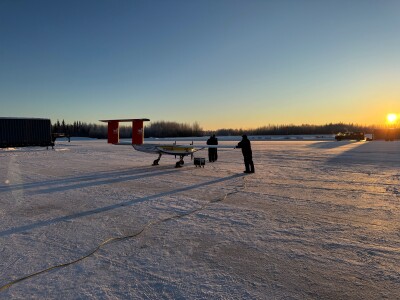
Alaska's operating environment provides opportunities to evaluate aircraft under conditions that may expose weaknesses in propulsion, batteries, navigation, communications, and flight-control systems.
As aircraft become larger and their missions more ambitious, the ability to demonstrate consistent performance across different environmental conditions becomes increasingly important.
Nine Test Sites and the Next Generation of Uncrewed Aviation
The nine FAA-designated test sites represent different geographic environments, institutional capabilities, and research priorities.
The established sites in Alaska, North Dakota, New Mexico, Nevada, New York, Texas, and Virginia were joined in 2026 by the Choctaw Nation of Oklahoma and Indiana, expanding the program's geographic and institutional reach.
Their combined capabilities support technologies needed for increasingly sophisticated operations, including automated flight management, improved airspace surveillance, long-distance communications, and aircraft capable of responding appropriately to unexpected conditions.
One significant challenge involves integrating these technologies into complete operational systems.
A manufacturer may develop an effective DAA sensor, another company may specialize in C2 communications, and a third may provide autonomous flight software. The performance of each component matters, but the reliability of the complete system ultimately determines whether an aircraft can operate safely.
The test sites offer opportunities to evaluate separate technologies and their interactions across aircraft, sensors, communications networks, ground control stations, and surrounding airspace.
The practical applications extend beyond conventional aerial photography and surveying. Long-distance infrastructure inspections, agricultural operations, medical deliveries, emergency response, and cargo transportation could all benefit from aircraft that operate reliably over extended distances.
For the Choctaw Nation, these possibilities are especially relevant to rural communities.
"For the Choctaw Nation of Oklahoma, our purpose is clear: we strive to enable practical services, including medical delivery and emergency response, that can improve life in tribal and rural communities," Grimsley explained. "Test sites help build the evidence and public confidence that make those benefits possible."
The next phase of uncrewed aviation will depend heavily on transforming successful experiments into dependable, repeatable operations. The nine FAA-designated test sites help manufacturers and operators understand what their aircraft can accomplish, where technological limitations remain, and which engineering challenges must be resolved. Those experiments also raise an equally important question: how does the FAA use the evidence generated at these facilities to determine which aircraft and operations it can approve?
That question will be the focus of Part 2 of this series, which examines the regulatory contribution of FAA-designated UAS test sites and their potential role in future BVLOS operations as we approach the formal issuance of Part 108.








Comments