

Sponsored by IPET
Offshore wind inspection, naval security, and automated drone-in-a-box stations along coastlines share one requirement. The aircraft must fly repeatedly in humid, salt-laden air. Salt crust buildup, galvanic corrosion, and moisture ingress are common causes of motor failure in these environments, and standard drone motors were not designed with them in mind.
IPET, a UAV propulsion manufacturer, built its N-Series for these conditions. This article reviews the engineering approach behind the series, including its sealed motor architecture, material choices, thermal test results, and corrosion and water-ingress testing.
Why Open Outrunner Motors Degrade in Coastal Air
Conventional open-frame outrunners are the most common motor design in multirotor aircraft. The rotor and magnets spin around a fixed stator on the outside of the motor, which helps shed heat but leaves the rotor, magnets, windings, and bearings open to the surrounding air. Enclosed outrunners exist, but they represent a small share of the market.
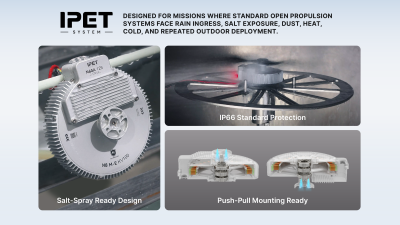
In coastal and offshore environments, that air carries salt. Over repeated flights, deposits build up on exposed surfaces, and moisture combined with salt speeds up corrosion on bearings, fasteners, and electrical interfaces. For operators, the result is more frequent maintenance and less confidence in long-duration inspection schedules.
The N-Series uses a sealed inrunner architecture. The rotor spins inside a closed housing, which physically isolates the electromagnetic components from the outside environment. Salt and moisture have a much harder path to the parts most vulnerable to damage.
Material Selection and Corrosion Resistance
The N-Series housing is made from 6061-T6 aluminum with an anodized finish, paired with stainless-steel hardware. Material pairing matters because of galvanic corrosion. When two dissimilar metals touch in the presence of an electrolyte, the more reactive metal corrodes faster than it would on its own. Salt moisture is an effective electrolyte.
According to IPET, the combination of anodized aluminum and stainless-steel hardware effectively mitigates galvanic corrosion risk in high-salinity air. Fasteners and electrical interfaces are among the most common corrosion points on coastal aircraft, so hardware selection carries as much weight as the housing itself. Operators assessing any propulsion system for marine use can ask how the design handles contact between different metals at these points.
Managing Heat in a Sealed Housing
Sealing a motor raises a fair question about heat. Without open airflow across the windings, a closed housing can trap thermal energy and shorten component life.
IPET reports bench testing to address this concern. The N-Series completed 500 hours of endurance cycling across a 40 percent to 80 percent throttle range. Housing surface temperature stayed stable at 50 to 51°C during the documented test conditions.
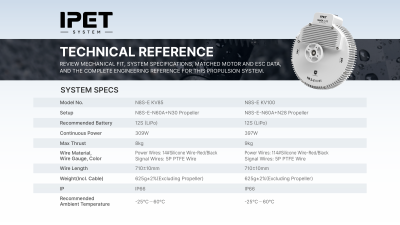
These are bench results. Field performance will vary with ambient temperature, payload, and propeller loading, so teams should treat the figures as a baseline for reliability assessment and maintenance planning and validate them against their own platform and climate.
Salt-Spray Testing and Ingress Protection
The N-Series was put through a 120-hour neutral salt-spray test. This type of test exposes a component to a continuous salt fog in a controlled chamber, which produces a repeatable measure of corrosion resistance on a fixed timeline. Field exposure cannot offer that consistency. The result gives coastal, port, offshore wind, and ship inspection operators a documented data point for comparing propulsion options.
The series carries IP66 ingress protection as standard. In practical terms, the first digit means the enclosure is dust-tight, and the second means it is protected against powerful water jets. IPET also states that IP67, which covers temporary immersion, is available on selected project configurations.
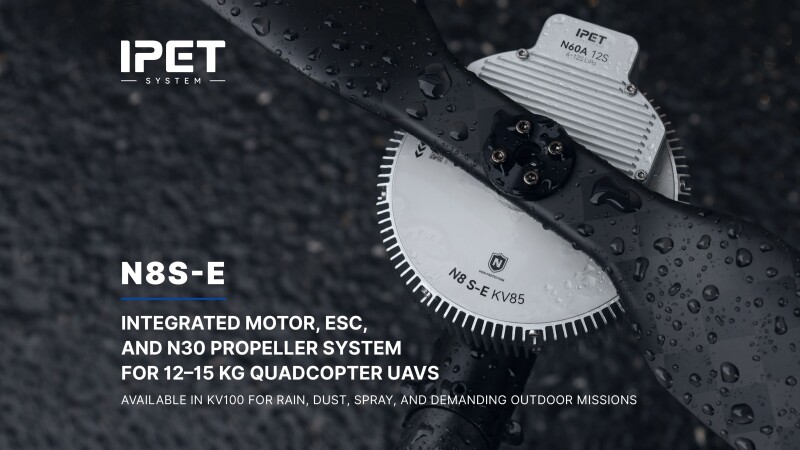
IPET integrates its N60A electronic speed controller (ESC) into the N8S-E, N8M-E, and N8-E configurations. This reduces external wiring and connection points, which are frequent failure locations in wet environments. The larger N8L supports a separate ESC for heavier platforms.
IPET has also published two demonstration videos showing harsh-environment and water-spray testing.
What This Means for Offshore and Coastal Operations
Offshore wind inspection, port and ship inspection, naval security, and automated dock stations all involve frequent flights in corrosive conditions with limited opportunity for hands-on maintenance. For drone-in-a-box systems that run on automated schedules, a single motor failure can interrupt an entire inspection program.
IPET states that all-weather capability depends on how motor structure, ESC integration, materials, electrical interfaces, and thermal behavior work together over prolonged exposure. An IP rating covers only part of that picture. Platform teams evaluating propulsion for maritime use can compare ingress protection, corrosion testing, and thermal data across those categories.
The N-Series covers quadcopter platforms from roughly 10 to 25 kg maximum takeoff weight across the N8S-E, N8M-E, N8-E, and N8L models, so it spans a range of mid-size industrial airframes.
Resources for Platform Teams
IPET publishes technical drawings, specifications, bench test data, and a solution dossier at https://www.ipetsystem.com/solutions/all-weather. Engineering teams can also contact IPET with their aircraft type, maximum takeoff weight, voltage, operating temperature, and expected exposure to rain, salt spray, dust, or washdown to narrow down a suitable configuration.










Comments