

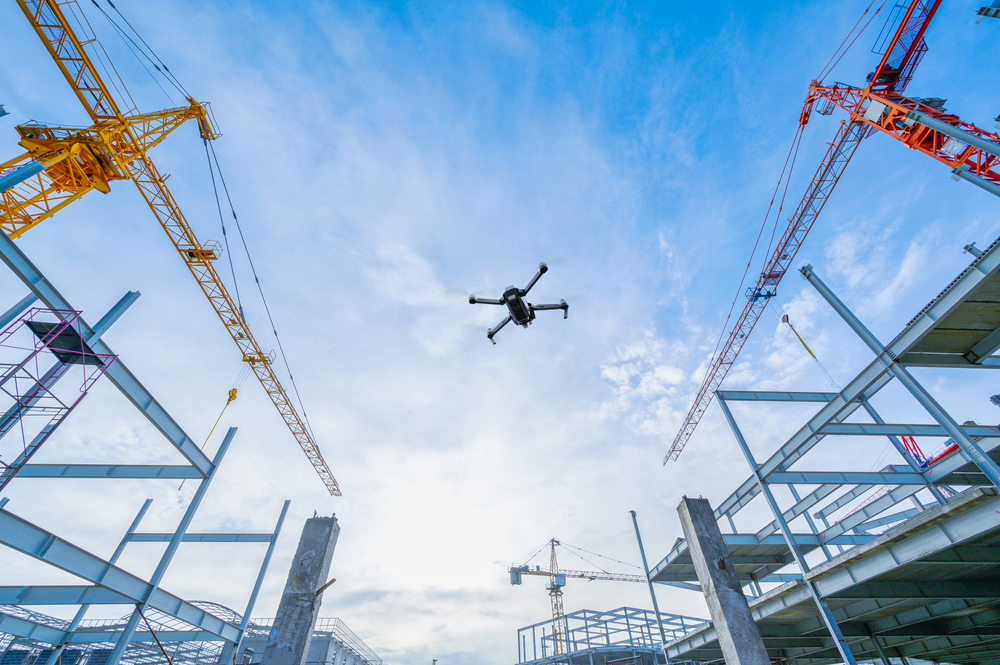
Anyone who has worked in or adjacent to the construction industry knows about its reputation for being averse to new technologies. In many ways, this is common for any industry that has been around for centuries, as proven workflows are difficult to displace, particularly for an industry like construction that generally works with small profit margins. Even with that being said, though, this reputation is often overblown and about 10 years out of date. Today, major construction projects are brimming with cutting-edge technologies as the industry has had to reckon with booming demand across a number of sectors, with many regions simultaneously working around worker shortages. These two factors have combined for a greater embrace of new tools.
The types of technologies can run the gamut depending on the type and size of the project, but one of the most common tools used on sites today is drones. Whether it’s to monitor progress, calculate volume of stockpiles, or connect to an internal BIM or GIS system, data collected by drones is a significant part of large-scale construction projects around the world.
Sisk, a major construction firm based in Ireland that works across Europe, is a perfect symbol of the evolution of the construction industry and how drones have created value for their projects. Founded over 150 years ago, they have seen first-hand the evolution of technology usage in the industry, and today offer an entire Digital Project Delivery service in which these tools – including drones – are put to use.
Recently, Commercial UAV News spoke with Cillian Kelly, the group head of Digital Project Delivery with Sisk, about how the company’s drone program has evolved from being a pipe dream to a massive part of their workflow, and how a recently announced partnership with DroneDeploy figures to expand that work. He also explained what his department works on, and how it helps both bring value to the rest of the organization and get buy-in from every level.
“We try and essentially build a team with industry experts to showcase what’s possible,” he said. “Then my job is to make sure that sits within the business that’s well established, and that project directors, site engineers, surveyors, everyone can understand the value and the benefits they get from digital technology and this way of working.”
Kelly entered his time with Sisk having previously studied architectural technology, giving him a background on this topic that would help reshape the way the company worked. However, it wasn’t a matter of suggesting adopting drones and then everyone buying in, something that won’t shock anyone who was trying to get their own organizations to adopt the technology 10-15 years ago. Instead, Kelly told Commercial UAV News, he was “laughed out of the room” the first time he pitched the idea. He noted feedback from leadership that it was just too early for them to adopt drones.
From there, though, things started to change. Previously, they had been contracting helicopter flights to take aerial footage of construction sites, but over time, as the price of drone photography began to drop, the financial sense started to shift away from using the helicopter and more toward using the drone. So, Kelly’s team began to contract a drone operator – who was actually the same photographer as they were using with the helicopter – and the value of this imagery became clear to everyone in the organization.

Still, there were more conversations to be had about how exactly this would work within the organization, and whether they would contract third parties or use their own in-house pilots. For a while, they had site engineers train and register with local regulatory bodies to be able to fly on project sites, but this was still only part of their job. For about five or six years, Sisk leaned on external consultants to do their work, which worked for the organization, with site engineers filling in gaps between other duties. Eventually, though, it became clear that shifting to an in-house team was the proper way to move forward.
“It wasn’t until we had a large spread of projects and we had maybe 30-plus sites to cover in one of our business units that a manager at the time was like, Hold on a minute. I’m going to spend more on that external company trying to cover all of these sites than just pay for a full-time drone operator,” Kelly recalled. “It wasn’t until that moment that one MD realized it actually made more sense financially that we can invest in it that we were able to put forward the business case to go to market and get the right candidate in.”
Today, Sisk works with an in-house pilot team led by Peter Naggi, who was hired at that time and remains with the team today. Additionally, their geospatial manager, Andy Ricci, is a certified drone operator and, with Peter, helps manage the data capture operations. While they do still outsource some of their operations to third parties in cases where the work may be further away, those teams still work closely with the in-house teams at Sisk.
The most recent development for Sisk’s drone operation, as noted above, is a recently announced partnership with DroneDeploy, which Kelly says, “allows us to capture and interpret site data with a level of speed and accuracy that simply wasn’t possible before.”
He told Commercial UAV News that they had previously been using DroneDeploy prior to this expanded partnership, but that was on a project-by-project basis. Eventually, however, they could see the value this was providing for individual projects of different types, and it clearly made more sense to expand their use.
“Quickly, we had one, two, three, four, five, six projects all having individual project licenses set up,” Kelly said. “So much so that an enterprise agreement made commercial sense.”
As anyone who has worked in technology would know, particularly within an industry like construction, it’s all about being able to prove the value to the organization’s leadership in order to drive that investment from the top. With DroneDeploy, the value was clear, and the sell wasn’t all that difficult, according to Kelly, who referred to it as “probably one of the platforms that was the easiest sell out of all the technology we’ve introduced into the business.”
Overall, it’s clear that the utilization of drones on projects across the board has been a value-add for Sisk, and that has only grown since bringing the pilot team in-house, and further with the expanded use of DroneDeploy. While using these tools isn’t necessarily required by all of their clients at this point, they still encourage it across the organization whenever possible.










Comments