

Contributed by Dr. Kenneth W. O’Connor and Gerry Goldstein
Picture a scenario that is becoming increasingly familiar across commercial drone programs.
A utility company expands its drone inspection coverage. The aircraft performs well, the pilots are trained, the software works, but the program still stalls.
Replacement batteries are on a long lead time. A firmware update creates compatibility problems with a key sensor. The support vendor is stretched thin. The drones sit. The inspections slip. A business case that looked compelling on paper becomes fragile in the field.
That story is not unusual. It is becoming one of the defining challenges of the commercial drone industry at scale.
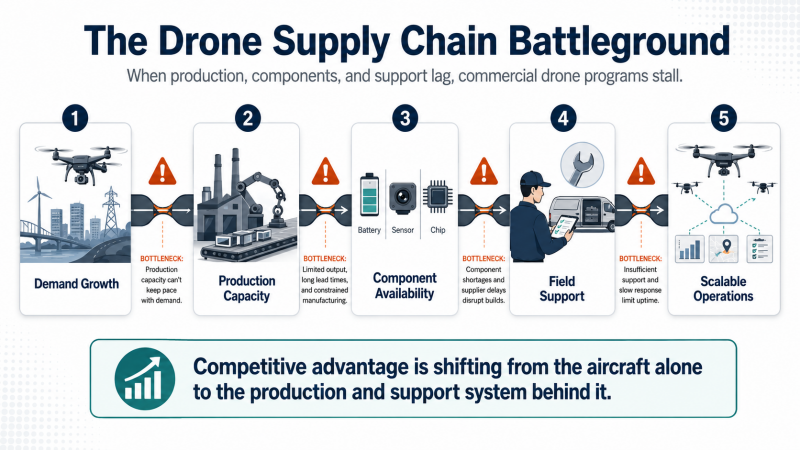
The technology works; that battle has largely been won. The next constraint is production. The market is moving from proof of concept to operational scale, and that shift exposes a difficult gap between what drone programs need and what the existing supply base can reliably deliver.
In some of the highest-demand segments, customers are beginning to think in terms of fleets rather than pilots. Yet many suppliers are still operating with production models better suited to small batches than rapid scale. That gap is the strategic problem of this moment, and it will not solve itself.
The Problem Is No Longer the Drone
For much of its early development, the commercial drone industry competed on the aircraft itself. Buyers looked closely at flight time, image quality, payload capacity, and ease of use. Manufacturers won or lost based on platform performance.
That era is not over, but it is no longer the defining contest.
The defining contest now is production. Not just whether a company can design a capable system, but whether it can build that system in volume. Can it deliver on time? Can it support the system in the field? Can it replenish parts when components fail or demand spikes?
For operators running inspection programs at utilities, infrastructure firms, construction companies, or public safety agencies, the central question is no longer only “Who builds the best drone?” It is also “Who can keep up when the program grows?”
A commercial drone rarely creates value by flying alone. The aircraft captures the image, but the customer needs a usable result. That result may be a maintenance decision, a faster repair, or a clearer view of an asset that would otherwise be expensive or dangerous to reach.
The drone is the entry point. The ecosystem behind it is what determines whether a program can actually scale.
That ecosystem is where the industry’s next competitive battles will be won and lost.
The Cost Math Is Changing
Enterprise customers cannot build serious operations around drone programs that depend on thin supply chains and long replenishment timelines.
A utility managing thousands of miles of infrastructure needs systems it can count on in volume. A public safety agency with a wide jurisdiction needs equipment that can be quickly supported. A logistics operator running frequent missions needs replacement parts without multi-month delays.
Cost per unit matters. Availability matters. The ability to replace a failed component without a long wait matters. As programs expand from pilot phases into full operations, tolerance for supply-chain fragility drops quickly.
This is where the industry’s early production model begins to show its limits. Boutique production helped many drone firms develop impressive systems. But a model built around small runs and long lead times can become a structural liability when customers need dependable output at scale.
Programs that outgrow their vendors do not just slow down. They can stall.
Surge Capacity Is the New Competitive Advantage
The word that increasingly defines what serious drone manufacturers need to demonstrate is surge.
Surge capacity means the ability to increase output when demand rises without sacrificing quality, dependability, or cost control. It does not simply mean having a large factory. It means having a supply chain designed for speed.
That requires manufacturing processes that can scale without years of delay. It requires suppliers that can respond quickly. It requires a production architecture flexible enough to absorb design changes without stopping the line.
This is where the commercial drone market still has ground to cover. Too many production models are optimized for craft rather than throughput. They can produce impressive systems, but not always fast enough to meet demand when customers move from trials to full deployment.
A utility expanding inspection coverage into a new region should not be at the mercy of a vendor’s production backlog. A public safety agency adding drone capability across multiple jurisdictions should not have to redesign its program around parts availability.
Speed is becoming part of the product. So is dependability. So is the ability to recover when demand or disruption hits. These are no longer premium features. They are becoming baseline expectations for serious commercial drone customers.
Resilience Is Not Optional
Supply-chain resilience has moved from a procurement preference to a buying requirement.
Recent disruptions have exposed how fragile many drone supply chains can be. For operators in infrastructure inspection, energy, construction, or public safety, that fragility is not an inconvenience. It is a program risk.
A drone program that depends on a single critical supplier can be halted by forces beyond the operator’s control. A component shortage can delay missions. A support bottleneck can ground aircraft. A single compatibility issue can ripple across an entire program.
Resilience means designing against those risks before they become operational failures.
That requires more than inventory. It requires supplier depth. It requires designs that can adapt when parts change. It requires manufacturers with real production capacity, not theoretical capacity that disappears under pressure.
Building that kind of resilience requires investment and discipline. It is also becoming a condition of doing business with serious commercial customers who have learned what supply-chain fragility actually costs.
Agility Closes the Loop
Speed gets systems into the field. Dependability keeps them there. Resilience absorbs shocks. But the quality that ties all of these together is agility.
Agility means taking customer feedback and turning it into improvement without an eighteen-month development cycle. It means adjusting production when requirements change. It means integrating a better sensor or battery without having to rebuild the system from scratch.
For operators in fast-moving sectors, vendor agility is not a nice-to-have. It is a program requirement.
The commercial drone market is changing quickly. Regulations are evolving. Customer expectations are rising. Use cases are becoming more sophisticated. A company whose production architecture is too rigid to adapt may find that yesterday’s capable system becomes tomorrow’s constraint.
This is why agility is ultimately a manufacturing problem, not just a software problem. An agile drone ecosystem needs production infrastructure that can respond to change as a normal part of business.
What This Means If You’re Running a Commercial Drone Program
The early question was whether drones could do useful work. That question has been answered across inspection, mapping, agriculture, public safety, and logistics.
The question now is whether the industry can deliver that work at the speed, scale, and reliability that serious operators require.
For program managers and procurement leads, this changes how vendors should be evaluated. Platform performance still matters, but it is only part of the decision. The deeper question is whether the vendor can scale with your program.
Can they replenish components on a timeline that keeps operations moving? Can they support the system after the initial sale? Do they have enough supplier depth to absorb disruption? What happens to your program if their primary supplier has a bad quarter?
For manufacturers, this is a call to rethink production as strategy. The operators running the largest and most consequential commercial drone programs are not shopping for technology demonstrations. They are looking for partners who can build fast enough to matter and hold up long enough to win.
The drone supply chain is no longer a background issue. It is the battleground.
The companies that treat it that way will be better prepared for the next phase of the market. They will build for speed. They will build for dependability. They will build for resilience. They will build for scale. And they will build with enough agility to adapt when the market changes.
The advantage will belong to those who can build fast enough to matter and hold up long enough to win.
About the Authors
O’Connor and Goldstein recently collaborated with MIT Sloan on a UAS feasibility study examining the commercial and operational viability of drone deployment at scale.

Dr. Kenneth W. O’Connor
Dr. Kenny O’Connor is a faculty member in the Department of Commerce at the University of West Florida, where his research focuses on supply chain logistics, technology adoption, autonomous transportation systems, and emerging industrial markets. He holds a Ph.D. in Marketing from the University of South Alabama and brings more than 16 years of parallel experience in academia and senior executive leadership in the construction sector.

Gerry Goldstein
Gerry Goldstein is a serial entrepreneur, former Wall Street investment banker, and faculty member in the MBA program at the University of West Florida. His career spans institutional finance at Merrill Lynch, founding one of the Southeast’s largest printing businesses, and active roles in regional economic development across Northwest Florida.







Comments