

In this week’s news round up, we look at stories covering Commercial UAV Expo 2026, a new flexible drone, and another impressive drone light show.
CUAV Expo Featured in Autonomy Global News
Our editor Matt Collins’ piece on the 12th annual Commercial UAV Expo in Las Vegas was featured in Autonomy Global. The event set records, drawing 3,800 verified professionals from all 50 U.S. states and 65 countries, with more than 250 exhibitors. It came at a pivotal time for the U.S. drone industry, with the FAA nearing a final Part 108 rule and the FCC’s restrictions on foreign-made drones and components creating cost and procurement challenges, especially for smaller firms. A State of the Industry survey from Commercial UAV News and Pilot Institute showed the FCC decision was respondents’ top concern, though optimism about the industry’s future remained. The closing keynote featured the FAA and EASA discussing their differing approaches to low-altitude airspace regulation: the FAA relies on field testing and real-world data, while EASA takes a risk-based approach through its SORA methodology. Both agencies expect their approaches to converge over time.
Procurement and Part 108 dominated the conference sessions. Discussions covered the legal implications of the FCC decisions and how operators should prepare for future purchasing, while exhibitors showed components that are already compliant or on a path to compliance. The final Part 108 rule hasn’t been released, but the FAA’s Rob Reckert said it is “on the 10-yard line” and the agency hopes to publish it by year’s end. Speakers cautioned that many operators won’t benefit right away, since implementation will take time. The piece closes by stressing the value of in-person networking, which it says builds connections and energy that remote communication can’t match.
Flexible Drone by ETH Zurich
ETH Zurich researchers Luca Girardi and Stefano Mintchev have developed FlexiQuad, a drone with a soft, ring-shaped frame and no central body. The rotors, batteries and control module are spread evenly around the ring, letting the frame deform on impact and absorb collision energy. Inspired by the wings of birds and insects, the frame flexes laterally but stays stiff vertically so the rotors can still deliver the forces needed for flight. Despite its flexibility, the drone reaches speeds of up to 80 km/h (50 mph) with accelerations comparable to rigid drones, and it kept flying after being flown into obstacles at around 25 km/h (16 mph). A patent application has been filed, and the invention is nominated for this year’s Spark Award.
The team envisions uses in cluttered environments such as inspecting ship ballast tanks, searching collapsed buildings, and taking measurements in dense forests, as well as capturing rogue drones with a net in the hollow center. The frame can also grasp and carry objects, including a soft first-aid kit and a payload heavier than the drone itself. The design is modular and cheap, with airframe materials costing under 15 Swiss francs, and it folds flat to fit in a medium-sized suitcase. Before it can leave the lab, FlexiQuad still needs reliable perception and autonomous navigation. The team has used reinforcement learning to teach it to stabilize itself after a collision and resume flight, and is exploring whether the frame’s own bending and vibration could provide additional flight-control feedback.
Mesa Arizona Holiday Drone Light Show
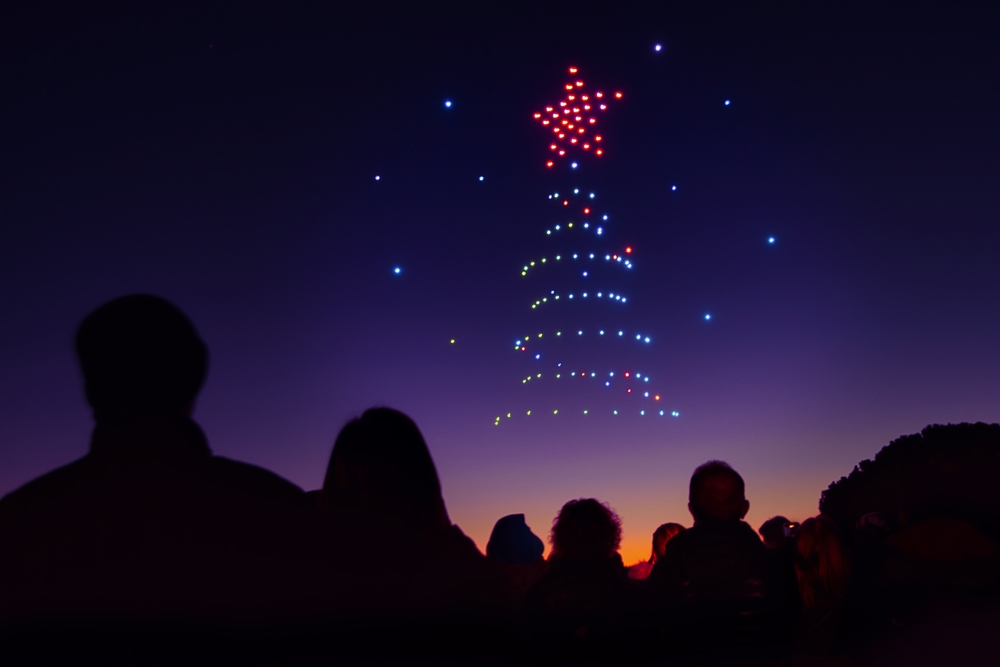
Drone light shows are quickly becoming a training ground for the next generation of designers, and a new case study from Pulse Drone Light Shows shows how. The Phoenix-area company produced a 100-drone holiday spectacle for the City of Mesa and Mesa Arts Center’s Merry Main Street celebration on November 28, 2025, and the creative work came from students. Arizona State University’s Drone Show Design Program storyboarded and designed the show, with students working alongside the Pulse team through ASU’s MediatedX Lab. The event also marked the launch of a three-way partnership among the city, the university and Pulse that puts students at the center of real production work.
The staging was smart: Pulse placed the drones directly behind the event stage and its towering Christmas tree, giving the audience a single, cohesive view. The client clearly noticed the payoff, saying the show took up far less space than expected and made logistics easy, and organizers signaled they’d be in touch about next year. That enthusiasm has carried forward. Pulse has since flown a 300-drone show for Mesa on July 4, 2026, and its recent portfolio also includes a 100-drone space-themed show for Tempe Jam and 11 Friday-night shows for the Aqua Nights summer series at JW Marriott Desert Ridge. For a young industry, the Mesa model offers a promising blueprint: pair a city’s event needs with a university’s talent pipeline and a production company’s expertise.







Comments