

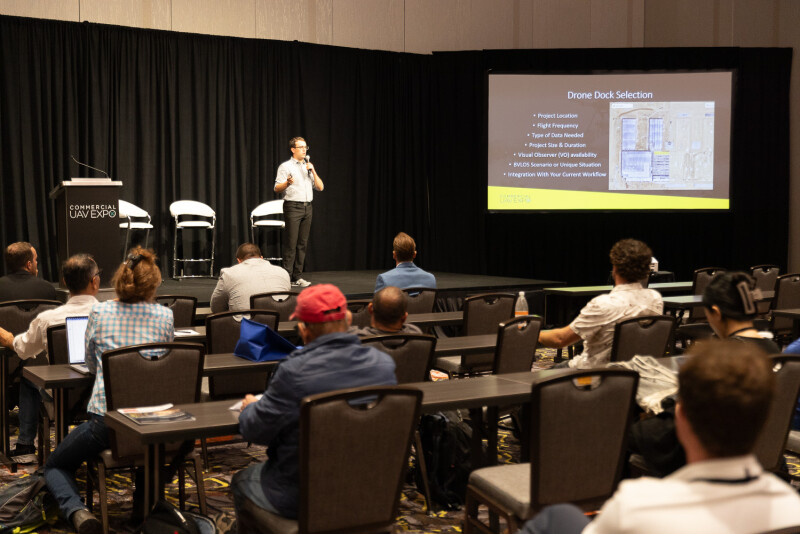
As commercial drone operations push further into controlled airspace, contested environments, and regulatory gray zones, the margin for error can feel like it’s shrinking. A handful of sessions at Commercial UAV Expo 2026, running September 1-3 at Caesars Forum in Las Vegas, tackle the operational and policy realities behind that shift, from courtroom-tested regulatory strategy to lessons pulled from the world's harshest operating conditions.
Operators navigating today's patchwork of federal, state, and local drone rules face more than compliance headaches. As will be discussed in the session How Smart Operators Are Turning Regulatory Complexity Into Competitive Advantage, that patchwork can also become a source of real legal and operational exposure when the gap between what a rule says and what it means in practice goes unaddressed.
Moderated by the FAA's Jessica Jones, the panel brings together Robert Ellis of Hennis, Rothstein & Ellis LLP and Kevin Houston of Manna Air Delivery to unpack how federal, state, and local authorities interact and where those boundaries remain unsettled. The conversation moves past treating regulation as a checklist, framing it instead as a strategic variable that can shape fleet planning, capability investment, and business positioning. The session runs September 3 from 10:30 to 11:30 AM.
Running the same time slot, Where the Airspace Gets Complicated: Operating Professionally in Controlled and Urban Environments digs into what happens after approval is granted. This session, which features a series of presentations from real-world operators, argues that authorization is only the starting point. Sustained access depends on communication, professionalism, and stakeholder trust built over time.
Lindsey Dreiling of Dreiling Aviation Services will present on integrating UAS operations into active airport environments, drawing on firsthand experience coordinating with air traffic control inside Class D airspace. Alex Norman-Elvenich of Matternet follows with a look at sustaining drone delivery in dense urban and controlled airspace across three continents, including routine BVLOS delivery in Central London for the NHS. Carlos Femmer of HDR Engineering will present on a handful of complicated operations from his team around the U.S. Each of the presentations focuses on the operational discipline needed to convert one-off approvals into long-term, sustainable access.
The FAA's Section 2209 NPRM on facility restrictions is opening the door to something bigger: statewide frameworks for air domain awareness and counter-UAS planning. In From Section 2209 to Statewide CUAS Strategy: Building Air Domain Awareness Through Policy, Infrastructure, and DHS Funding, Kenji Sugahara of the Oregon Department of Aviation examines how states can turn that rulemaking into practical governance, covering validated Remote ID detection, interoperable sensor architectures, and defensible overflight processes.
The session also connects those policy choices to emerging DHS funding opportunities, including FEMA-administered grants that could support detection, training, and coordination efforts. Attendees will leave with a framework for aligning federal rules, state authority, and infrastructure investment. It takes place on September 3 from 1:30 to 2 PM in the Forum Theater, making it available to all attendees.
Real-world safety data drives real-world improvement, and the UAS Safety Reporting: Amplify Your Voice panel puts that principle into practice. Moderated by Elisa Marfise of Booz Allen Hamilton and NASA Ames Research Center, the session walks through de-identified reports drone pilots have submitted to NASA's Aviation Safety Reporting System, examining the decision points and mission dynamics behind them.
Matthew Davis of Censys Technologies and Michael Leo of FDNY Robotics join the panel to translate those lessons into practices that UAS crews can fold into their own procedures. The session runs September 2 from 12:00-1:00 PM.
Closing out this group of sessions, What Commercial Drone Operators Can Learn From the Hardest Environments in the World looks at technology forged under extreme conditions and now migrating into everyday commercial use. Joseph Segura-Conn of Doodle Labs opens with a look at how resilient communications, autonomy under degraded conditions, and scalable networking, capabilities first developed for defense and contested environments are now improving reliability in urban inspection, long-range surveying, and BVLOS operations.
Kanwar Singh of Skyline Nav AI follows with a pointed look at GPS vulnerability. His presentation details how jamming and spoofing threaten drones used in cargo transport, agriculture, and infrastructure monitoring, citing findings that spoofing can push positioning errors past 100 meters and jamming can cut mission completion rates by 40 percent. The session makes the case for GPS-independent navigation as a near-term necessity rather than a future consideration. It runs September 3 from 2:00 to 2:30 PM in the Forum Theater.
Taken together, these five sessions trace a throughline for operators scaling into more demanding work: regulatory fluency, operational discipline in contested airspace, coordinated policy infrastructure, a culture of safety reporting, and technology built to withstand conditions far harsher than those at a typical job site. For operators looking to move beyond routine operations, this track offers a working playbook drawn from people who have already been there.





Comments