
World War I began in the summer of 1914, 12 years after the Wright Brothers’ first flight of an engine-powered, heavier-than-air aircraft. By then, airplanes had reached a semi-homogeneous design consisting of two wings, one at the bottom and one at the top of a single fuselage made of wood and covered in specially treated canvas; a single engine at the front; and an open cockpit with a pilot and, in some cases, a passenger. This rudimentary design changed the course of history. These aerial vessels could be used to take photographs and create 3D maps at the dawn of aerial photogrammetry, providing something no general had before: a view from above the battlefield.
On top of that, planes could be used to drop bombs on the enemy, transport small quantities of supplies across enemy lines, along with a long list of other smaller tasks. To put it simply, aircraft changed the way humankind conducted war forever.
A similar phenomenon happened in February of 2022 when Russia invaded Ukraine, a decade after what most experts consider the beginning of the uncrewed aviation industry. Now, drones have changed war forever, not only on the offensive side, but an entire new industry, C-UAS (counter-uncrewed aerial systems), was born.
While these are all developments around the military and defense side of the industry, what does it mean for the commercial and civilian side?
We are about to find out.
The Drone Industry Has Run Out of Patience
As the uncrewed aviation industry prepares to gather in Las Vegas for Commercial UAV Expo 2026, it is difficult to escape a sense that the sector has reached a turning point. The technology has never been more capable, investment has not disappeared, and the potential market for autonomous aircraft remains enormous. Yet many companies that were built around the promise of routine commercial drone operations are struggling to generate meaningful profits, investors are becoming increasingly selective, and the industry is still waiting for the regulatory framework that could finally unlock large-scale BVLOS operations.
At the center of that uncertainty is the FAA's proposed Part 108 rule governing BVLOS operations in the USA, accompanied by the proposed Part 146 framework for Automated Data Service Providers (ADSP). The FAA published its proposed BVLOS rule in August 2025, describing it as a framework intended to normalize operations such as package delivery, agriculture, inspections, aerial surveying, and public-safety missions. The proposal would establish standardized requirements for operations, aircraft, safety, security and airspace integration rather than continuing the current system of waivers and individual approvals.
The industry's frustration is understandable because the financial clock has been running out for years.
The Money Is Still There, But It Has Changed Its Mind
One of the most revealing developments in the drone industry is that investment has not actually collapsed. Instead, it has become dramatically more selective. Global drone investment reached approximately $3.86 billion in 2025, a record, according to Drone Industry Insights, following a steep decline from $3.67 billion in 2021 to $1.79 billion in 2023 and to approximately $879 million in 2024. Even more striking, roughly $1.7 billion was invested during the first two months of 2026.
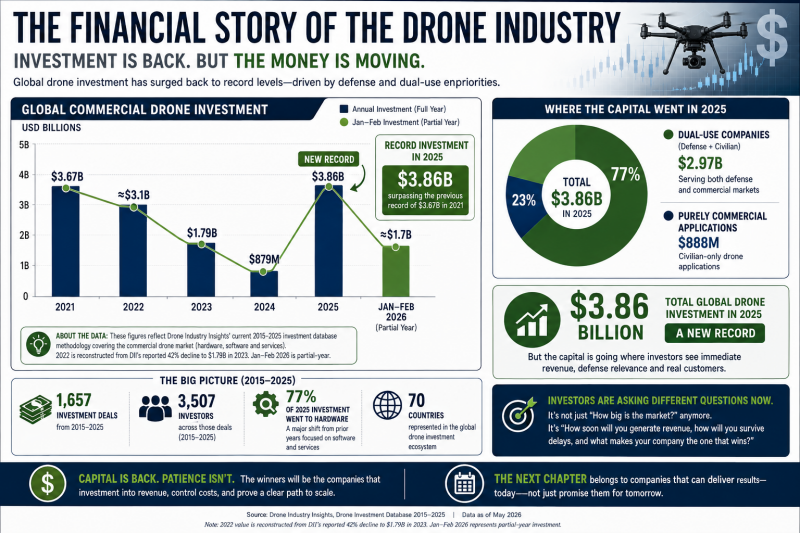
At first glance, those numbers suggest that investors remain extraordinarily enthusiastic about drones. But there is a major qualification: Approximately 77 percent of the 2025 investment went into dual-use companies serving both civilian and defense markets. Only about 23 percent went into purely commercial applications.
That shift tells us almost everything about the current investment environment. Investors are still marginally interested in autonomy, robotics, or unmanned aircraft, but they have become far less willing to finance companies whose business plans depend on regulatory changes that may occur in the future.
Defense has become the industry's financial safety valve. Military drones, C-UAS technology, autonomous systems, intelligence and surveillance, domestic manufacturing and other dual-use technologies are attracting capital because customers are already buying them. Commercial companies, by contrast, often ask investors to finance another year or two of development, certification, and regulatory uncertainty before their markets scale.
The result is an uncomfortable paradox: the drone industry is attracting record amounts of capital while many individual drone companies are struggling to survive.
There is also no reliable global database showing exactly how many drone companies have gone bankrupt. That number is difficult to establish because startups frequently disappear without formal bankruptcy, instead shutting down, selling their intellectual property, being acquired, restructuring, or quietly running out of money. Volansi, once one of the most prominent American drone-delivery companies, filed an assignment for the benefit of creditors in 2022. Swedish drone-delivery company Aerit filed for bankruptcy in 2024 after failing to secure additional funding, and the biggest of them all, Airware, after raising $118 million.
These failures illustrate the fundamental problem facing the commercial sector: Technological capability has advanced much faster than the regulatory and economic environment needed to support scalable operations.
Parts 108 and 146 Could Be the Catalyst, but It Won't Be a Magic Wand
This is why the timing of Parts 108 and 146 matters so much.
The FAA's proposed framework could fundamentally change the economics of commercial drone operations by establishing a more predictable path to BVLOS operations. Instead of every company having to negotiate its own regulatory solution, standardized rules could allow operators, manufacturers, and service providers to build businesses around known requirements.
Part 146 is key to the success of the new ruling because it addresses the infrastructure behind scalable BVLOS operations. ADSPs could become part of the system that supplies the information and services necessary to safely separate unmanned aircraft from other traffic.
But there is an important distinction that the industry should not lose sight of: publication of a final rule will not instantly create a multibillion-dollar commercial drone market. It will open the door, but we still have to go through it.
Companies will still have to demonstrate compliance. Aircraft will still have to meet applicable requirements and certifications. Operators will still need approvals, procedures, infrastructure, and insurance. Communications, Remote ID, airspace awareness, safety systems, and other operational requirements will remain critical.
In other words, Parts 108 and 146 can remove a major barrier to commercialization, but they cannot eliminate every barrier.
The FAA's own regulatory process also counsels patience. The proposed BVLOS rule is now in the final-rule stage, but the government's timetable has already slipped once. That makes it difficult to predict precisely when the final rule will appear or how closely it will resemble the proposal.
There is nevertheless strong evidence that the process is moving forward. The FAA has continued advancing commercial drone initiatives in 2026, including environmental reviews for expanded drone-delivery operations by companies such as Wing, and the constant bombardment of news about new delivery test markets by Amazon and others, including air taxis for human passengers.
The question facing the industry is therefore no longer simply whether BVLOS regulation will eventually arrive. The more consequential questions are when it will arrive, what the final requirements will look like, how quickly approvals can follow, and whether the companies currently waiting for the regulatory door to open will have enough cash to walk through it.
Las Vegas Could Reveal Who Is Ready for the Next Chapter
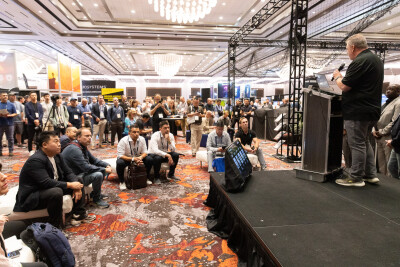
That is what gives Commercial UAV Expo 2026 the potential to be so significant.
The industry may be entering a consolidation phase rather than another indiscriminate growth phase. Investors are increasingly asking questions that have little to do with futuristic market projections and more with business models and sustainability. They want to know who has customers today, who generates recurring revenue, who has defensible intellectual property, who can manufacture at scale, who can survive another regulatory delay, and who has a credible path to profitability.
The old investment pitch was relatively simple: build the technology, obtain regulatory approval, unlock BVLOS, scale operations, and eventually achieve attractive economics.
The problem is that the regulatory step took much longer than many companies anticipated. Startups have spent years paying engineers, pilots, certification specialists, insurance premiums, and manufacturing costs while their potential markets remained artificially constrained.
That has created a Darwinian moment for the industry.
Some companies will arrive in Las Vegas saying they are ready for Parts 108 and 146. Others will say they desperately need it. Still others will barely mention it because they have already pivoted toward defense, government contracts, or dual-use applications.
The investment data suggests that the third group may have the strongest financial position.
The commercial drone industry has not run out of money. It has run out of patience.
That distinction may define the next three years.
Parts 108 and 146 could provide the regulatory catalyst that commercial aviation has been waiting for, but the companies that would benefit the most may not necessarily be the companies that raised the most money during the industry’s boom. They will be the companies that survived long enough to reach commercialization, developed real customers, controlled their costs, and built products that solve problems people are willing to pay to solve.
As the industry gathers in Las Vegas, the most important question may not be, “When will the drone revolution begin?”
It may be considerably more consequential:
I can’t wait to get there!






Comments