

.jpg.medium.800x800.jpg)
The reality of BVLOS flights is rapidly shifting more toward a regulatory question and less toward a technological one. The aircraft, communications links, navigation, traffic management systems, and detect-and-avoid (DAA) technologies needed for these operations have advanced considerably. The more difficult question is how aviation authorities can turn those capabilities into repeatable, commercially viable operations without evaluating every flight as a special case.
That is where the international picture becomes particularly revealing.
The United States remains one of the world's most sophisticated aviation markets, but its general BVLOS framework is still in transition. Under today's Part 107 rules, visual line of sight remains the baseline, and BVLOS generally requires a waiver or another form of FAA authorization or exception. Section 107.31 is specifically among the provisions for which the FAA may grant a waiver. The FAA published the NPRM for Parts 108 and 146 in August 2025, and it was intended to open a comment period for the general public to opine about the creation of a more systematic framework for BVLOS operations, including aircraft requirements, operational authorizations, separation from other aircraft and safety responsibilities, while also helping to define the role of the data service providers (DSP) that would make the entire proposal viable.
That new law is potentially transformative, but it is important to note that the United States’ proposed framework comes at a time when several other countries have already begun operating within theirs.
To frame this conversation, it makes sense to look at the incredible statistics of Zipline in Africa. Since launching its first commercial flights in Rwanda in October 2016, the delivery company has turned BVLOS drone delivery from an experimental concept into a large-scale logistics operation across the continent. What started as two hospitals has evolved into a national-scale autonomous logistics network, with Rwanda now expanding its partnership with Zipline to provide nationwide coverage, including an urban delivery network and an autonomous-delivery testing center, the first of its kind in Africa.
Zipline also operates in Ghana, Nigeria, Côte d'Ivoire and Kenya, creating one of the world's largest commercial BVLOS networks. By 2021, the company reported serving more than 2,300 health facilities and delivering more than five million vaccine doses, demonstrating that BVLOS is now part of the critical national infrastructure.
By January 2026, Zipline had surpassed two million commercial deliveries and more than 125 million autonomous commercial miles, with the company reporting that its aircraft had transported more than 20 million individual items without a serious injury, and all of these flights had been conducted under BVLOS rules, demonstrating that BVLOS can be integrated into national infrastructure, operate repeatedly at commercial scale, and deliver measurable social and logistical benefits.
We all understand that operating in the open skies of Africa cannot be compared with the challenges of an urban metropolis in the U.S. or Europe, but Zipline's experience should serve as a reminder that the technology is ready.

BVLOS regulations around the world are heavily dependent on the particular circumstances of the geography, how busy the skies are, and what type of operations are conducted on a daily basis.
Canada currently offers perhaps the clearest model for commercial operators. Its regulatory changes, which took effect in November 2025, created a pathway for lower-risk BVLOS operations without requiring the same kind of individual authorization traditionally associated with complex drone flights. The framework establishes operating conditions around airspace, altitude, population density and operator competency, while more complex BVLOS operations remain subject to additional authorization.
Rather than asking whether a particular flight should be allowed, Canada’s civil aviation authority, CAA, is beginning to define which classes of flights are sufficiently low risk to be allowed as a matter of regulation.
Australia is experimenting with precisely this problem. Australia’s CASA's broad-area BVLOS trial, launched in October 2025, establishes four pathways based on aircraft size, speed and population density. The objective is to permit qualified operators to plan and fly across larger areas with fewer approvals and greater flexibility. CASA uses its AusSORA framework to assess BVLOS operations.
The United Kingdom is pursuing a similar destination, although through a somewhat different regulatory pathway. The UK Civil Aviation Authority has published a BVLOS roadmap explicitly targeting routine BVLOS operations by 2027. Its roadmap identifies operational scenarios available today, as well as the regulatory and airspace architecture needed to expand them through 2027 and beyond. The UK has also begun creating more practical pathways for infrastructure inspection, including applications involving power lines and wind turbines.
Europe is taking an even broader approach. Under the EASA framework, BVLOS commonly falls within the Specific Category, where operators can use SORA (Specific Operations Risk Assessment) to determine the risk of an operation and the mitigations and safety objectives required. SORA connects the characteristics of the flight with operational limitations, personnel requirements, technical requirements, and procedures.
The European innovation is that SORA is being combined with U-space, creating an architecture intended not simply to authorize individual BVLOS flights but to manage increasingly dense unmanned traffic. EASA's June 2026 rules update continues that evolution.
Japan demonstrates what happens when a regulator goes one step further. Its Level 4 framework permits BVLOS operations over populated areas under a system that combines aircraft certification, remote pilot certification, and operational approval. Japan's regulatory architecture therefore provides something that is still largely absent from the U.S. commercial market: a defined legal category for genuinely advanced BVLOS operations rather than treating them primarily as exceptions to a VLOS rule.
Brazil is now moving in the same general direction. ANAC's RBAC 100, formally issued in June 2026, establishes a new regulatory structure for unmanned aircraft and explicitly defines BVLOS operations. The new framework is intended to replace the older RBAC-E 94 structure and represents Brazil's transition toward a more modern, risk-based regulatory system.
Speedbird Aero co-founder and CEO, Manoel Coelho, provided details about his company’s operations in Brazil.
“When Speedbird received the approval to fly over populated areas of 5,000 people per square kilometer or below, we became the first company to operate BVLOS flights before the implementation of RBAC100. Now our authorizations are carrying over to the new regulation in Brazil, and also we fly in Portugal and Italy using the SORA risk assessment tools."
Finally, Colombia, a surprisingly advanced market for uncrewed aviation, has regulated BVLOS for quite some time now. Robert Quiroga, former advisor to the Colombia Civil Aviation Authority, who helped write the law, was quite clear about the status of the legislation.
“Colombia has developed a specific regulatory framework to enable the evolution of UAS toward more complex operations, including BVLOS operations. The main instrument is RAC 100 – Operation of UAS, issued on September 27, 2023. In particular, section 100.445, ‘Special conditions for BVLOS operations’ establishes the conditions that certified operators must meet in order to carry out this type of operation,” Quiroga said.
“The Colombian model does not consider BVLOS capability to be derived solely from the technical characteristics of an aircraft. The operation requires an integrated capability demonstrated by the operator, which includes certification, BVLOS operational capability, authorized area, flight authorization, and compliance with the technical and operational safety conditions established by the aviation authority.”
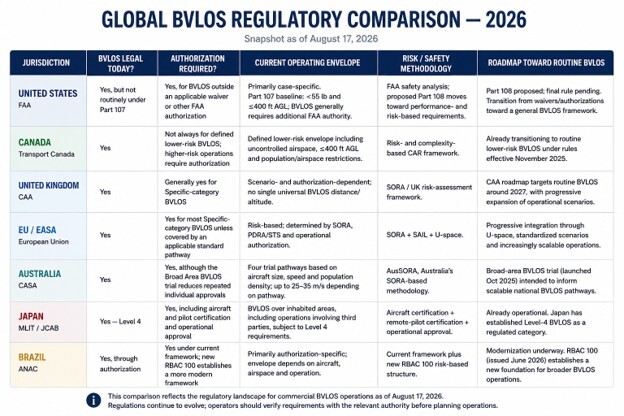
The most important conclusion from this multi-country comparison is that the international regulatory race is about who makes BVLOS commercially viable, and that distinction matters enormously for surveying, mapping, the distribution of food and life-saving supplies, and infrastructure inspection.
A company can obtain a one-off BVLOS approval to demonstrate that a drone can safely fly beyond the pilot's line of sight. That is a technical achievement. But it does not necessarily create a business. A scalable business requires predictable operating conditions, standardized equipment requirements, repeatable risk assessments, manageable insurance and training costs, and an authorization process that does not grow linearly with the number of missions.
Canada is addressing that problem through defined lower-risk operating privileges. Australia is testing standardized broad-area pathways. The UK has established a timetable for routine BVLOS. Europe is building the larger U-space architecture needed to accommodate many operators simultaneously. Japan has already demonstrated that highly advanced BVLOS can be a regulated category, and Brazil is already moving forward with thousands of food deliveries a day under BVLOS conditions.
The United States has pieces of these different systems, but they remain fragmented. The FAA has extensive experience with authorized BVLOS package-delivery operations, and its current UTM concept anticipates multiple BVLOS operators sharing low-altitude airspace. But the general commercial operator still encounters the fundamental limitation of Part 107: BVLOS is not yet a normal operating privilege.
That makes the delay surrounding Parts 108 and 146 strategically significant.
The issue is not simply whether American drone operators will eventually be allowed to fly beyond visual line of sight. They almost certainly will. The more consequential question is how much regulatory friction will remain between authorization and routine operation.
If Part 108 ultimately creates clearly defined risk classes, standardized technical requirements and predictable pathways for low- and medium-risk operations, the United States could rapidly close the gap. Its enormous aviation market, technology base and existing drone ecosystem would give it substantial advantages.
If, however, the final system remains heavily dependent on individualized approvals, the regulatory gap could become an economic issue. Companies in Canada, Australia, Brazil, the UK, Colombia and Japan may gain experience operating commercially at scale while American companies spend more time proving that individual operations are safe.
The global lesson is therefore surprisingly consistent: BVLOS is becoming a regulatory operating class and should coexist with VLOS separate regulation. In the US, the FAA has telegraphed unequivocally that Part 107 is here to stay and that, in a short period of time, they will issue Part 108 and Part 146 to remain globally competitive.










Comments