

This week’s news round up looks at a recent live BVLOS demonstration, a new roof-top docking system for food delivery, and a new platform to help pilots with regulatory questions.
Northern Plains UAS Test Site BVLOS Demonstration
The Northern Plains UAS Test Site (NPUASTS) hosted live BVLOS drone demonstrations on North Dakota's Vantis system at Gorman Field on September 16, 2026, for state aviation officials attending the NASAO Annual Convention. Partners including CVS Health, SkyfireAI, Kelly Hills Unmanned, and Thales showcased two real-world applications such as medical supply delivery (via CVS Air Response's mobile pharmacy concept) and agricultural operations where they demonstrated how Vantis's statewide infrastructure can support multiple aircraft types and use cases at scale.
Leaders from NPUASTS, CVS Health, and Thales framed the event as proof that North Dakota's ecosystem of aircraft, infrastructure, and operational expertise can move BVLOS drone operations from concept to practical, scalable reality. NPUASTS, one of nine FAA-designated UAS Test Sites, administers Vantis and continues to focus on advancing autonomous technology research, commercialization, and safe integration of UAS into the
Rooftop Docking for Deliveries by Flytrex
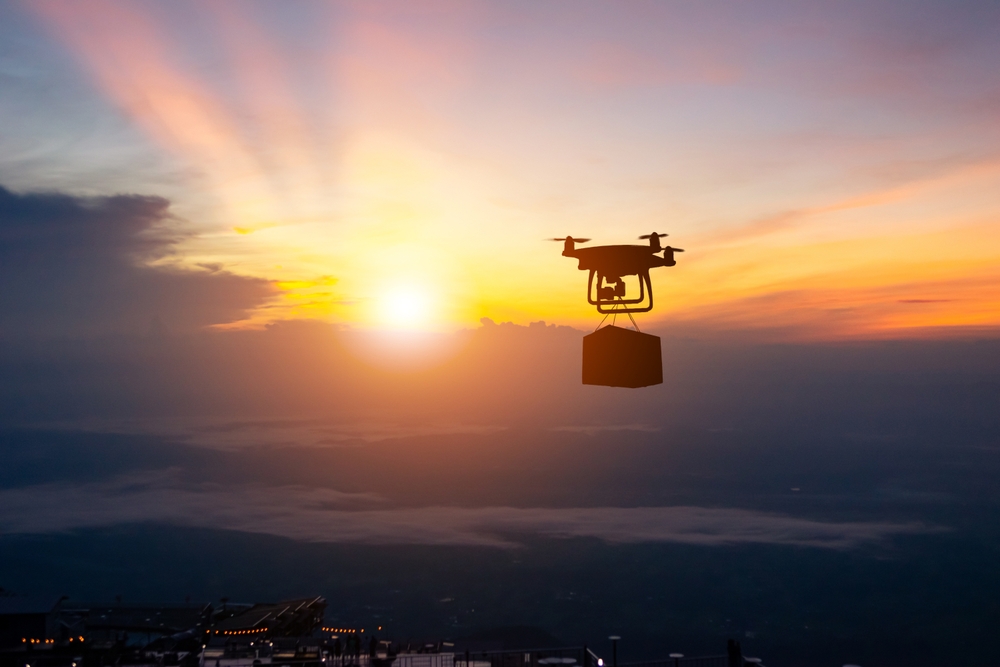
Flytrex is launching a new rooftop dock system at active merchant locations across Dallas-Fort Worth, with plans to install it at more than 100 additional sites. The dock sits on existing rooftops or elevated areas near restaurants, eliminating the need for drones to fly from a central launch point to pick up orders or for runners to ferry food to a separate site. Instead, a drone waits on the roof, powers down until an order is ready, then lowers a hook so staff can attach the package without touching the aircraft before it flies straight to the customer. CEO Amit Regev says the system, paired with machine-learning models that predict demand by location and time to position drones in advance, targets the "last few hundred feet" problem between kitchen and aircraft, aiming to boost speed, deliveries per drone, and cost efficiency while cutting the need for couriers or on-site Flytrex staff.
The rooftop model builds on a string of recent milestones for Flytrex, which says it has completed over 250,000 U.S. deliveries. The company has partnered with Uber Eats and DoorDash in the Dallas-Fort Worth market, received FAA approval for beyond-visual-line-of-sight operations, launched its Sky2 drone (capable of carrying up to 8.8 pounds) via a Little Caesars partnership, and opened a Texas manufacturing facility capable of producing about 1,000 drones per year. The new dock system still depends on suitable rooftop sites and regulatory approval, but if it scales successfully, it could let Flytrex serve more merchants with the same fleet size and less ground staffing.
Flyby Guys Launches Drone Assistant for Regulatory Advice
Finnish drone operator Flyby Guys has launched Drone Assistant, a platform at droneassistant.com that helps commercial operators determine which drone regulations apply to a given operation, country, and set of conditions. Rather than functioning as a general chatbot, it converts official aviation regulations, EASA guidance, and jurisdiction-specific data into structured, versioned requirements, then answers plain-English questions with citations back to the original sources, flagging when evidence is insufficient rather than guessing. It's aimed at commercial operators working internationally, enterprise and BVLOS/Specific Category programs, drone delivery companies, and compliance teams, and explicitly provides regulatory information rather than flight clearance or professional advice.
The launch coincides with the company's Drone Regulation Index 2026, which compared regulatory environments across 31 markets; Austria and Latvia tied for the top score (83.6), followed by Poland, Germany, and Ireland, while Finland was classified as provisional for narrowly missing one evidence threshold. CEO Stephen Sutton said the tool grew out of Flyby Guys' own struggles cross-referencing scattered regulatory sources while planning international operations, and the company is now inviting operators to test the platform against real-world regulatory questions as coverage expands over time.

.jpg.small.400x400.jpg)











Comments