

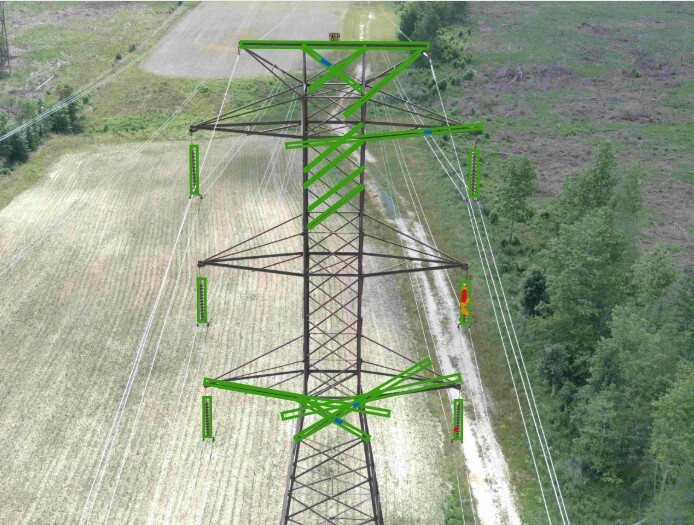
Few industries are as interesting as the utilities industry today. Demand is surging because of ever-increasing urbanization, along with recent growth in AI and related data centers. At the same time, climate change is driving more extreme weather events that disrupt power. The good news is that technological developments, including UAS, are making it easier than ever to collect imagery of key assets consistently, making planning new developments and maintenance easier. The bad news is that storing and working through all of that imagery provides its own challenges.
This brings us to Buzz Solutions’ PowerAI platform, the winner of the “software & data analytics” category in the Commercial UAV Expo Innovation Spotlight. The company’s flagship platform, PowerAI is designed to deal with that challenge of taking this abundance of data and seamlessly turning it into insights that can help, in their words, transform inspection imagery into operational intelligence.
PowerAI didn't start as the comprehensive platform it is today. Vik Chaudhry, co-founder, CTO and COO of Buzz Solutions, told Commercial UAV News the product launched in 2018 as a beta tool with a narrow focus: processing and analyzing imagery captured by drones and helicopter-mounted cameras during transmission and distribution line inspections. In its first commercial push in 2020, the company ran proof-of-concept trials with utilities and gathered feedback that shaped the platform through 2021, when the company won its first RFP with the New York Power Authority. That contract became PowerAI's first full-scale paid pilot, and by late 2022 the platform was deployed commercially in production.
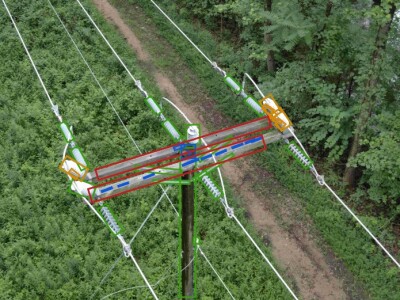
From there, PowerAI expanded well past image processing. The company added geospatial mapping so utilities could see where flagged assets sit on their networks, then built API connectors into asset management and work order systems like SAP and IBM Maximo.
"Now the platform has reached a stage where it's not just a point solution that's doing image processing or disparate kinds of point solutions with geospatial and workflow," Chaudhry said. It is a full platform that Buzz Solutions now describes as providing infrastructure intelligence across transmission, distribution, substation and solar assets.
That intelligence depends on the quality of the underlying data. Chaudhry said the company spent its first two and a half years focused almost entirely on building a varied imagery repository, starting with a partnership with the Electric Power Research Institute and expanding to work directly with utilities across different regions, use cases and infrastructure types. That foundation let Buzz Solutions train models first to detect equipment such as insulators, cross arms, dampers and spacers, then to identify specific defects, a harder problem given how many failure modes a single component can have.
The latest layer of that work involves vision language models that translate raw detections into plain-language recommendations for maintenance teams. Chaudhry was careful to distinguish these constrained, task-specific models from general-purpose large language models. "We are very much in an industry that is mission critical," he said, "and there's a reason why we cannot use LLMs like ChatGPT or Claude, because they hallucinate."
That emphasis on accountability carries into PowerAI's human-in-the-loop feature, which the company first piloted with the New York Power Authority. Rather than asking reviewers to check every image in a batch, the platform processes thousands of images in roughly an hour and surfaces only a prioritized subset, the detections flagged as most urgent or where the model has the least confidence.
"Instead of them manually going through every single image of a 10,000-image batch, they only get shown a subset," Chaudhry said. "Let's say 50 images, and those 50 images comprise the really critical issues that need repair within 24 hours, or where the AI has less confidence."
Reviewer feedback then flows back into the model, narrowing its confidence thresholds over time and adapting to how individual utilities prefer to prioritize risk.
That customization extends to onboarding. Chaudhry said new customers get platform access on day one, with training delivered within the first week, more hands-on for enterprise clients working through deeper system integrations. Most utilities start seeing measurable results in three to four weeks.
"They start seeing time efficiency, and work orders that are really accurate and give them insight into which ones to address first in a prioritized manner," he said.
The platform's users span a wide range of roles, from field technicians and drone operators entering data to GIS staff tracking asset locations to directors and vice presidents of transmission and distribution operations reviewing reliability and safety metrics.
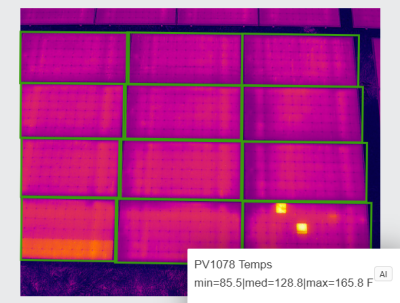
The company has also been expanding the kinds of data PowerAI can ingest. Thermal imagery now supports overheating detection on substation equipment and solar panels, and the company has begun layering in satellite data, which one utility customer uses to map wildfire risk zones before narrowing in on drone imagery for component-level detail. Chaudhry described the platform's growing role as a kind of connective tissue between data sources.
"We refer to our platform now as the connective tissue with different data sets, and AI running on top of it to get the analysis.”
Looking ahead, Buzz Solutions is exploring predictive modeling that would combine its years of inspection imagery with time-series data from outage management and advanced metering infrastructure systems, aiming to anticipate failures rather than just flag existing damage. The company is also building out near real-time analysis for autonomous drone docks through a partnership with Skydio, currently piloting with Dominion Energy, with plans to scale to additional utilities next year. Beyond that, Chaudry indicated further evolution is coming to the platform, with more news on that front in the near future.











Comments