


Across all industries, it can often feel from the inside that government regulation is working directly against innovation and growth for the private sector. In fairness, there are times in which that is the reality, but more often these regulations are necessary to grow the industry to its fullest potential, anticipating future problems and ensuring safe futures for everyone involved. In the most ideal scenarios, the public and private sectors work hand-in-hand to create regulations, something that has been exemplified throughout the short history of the commercial drone sector.
While this relationship hasn’t always been harmonious, there are clear examples of how public-private collaboration and partnership has led not only to fruitful business but truly impactful operations for local communities. Consider, for example, medical deliveries made by drones in rural and underserved areas. For these to happen, a private company needs to work with local regulatory bodies to enable these flights, which can then form the basis for more delivery work in the future, which can ultimately unlock new regulations around BVLOS.
This kind of relationship and how it leads to strong regulation is particularly important for the commercial drone industry now as we head into a key inflection point for the sector. BVLOS operations are becoming more and more of a reality, opening up new use cases for the technology while enhancing established verticals. AI and automation are reaching new heights across all industries and beginning to shift work for UAV professionals. Security threats from drones are also growing on both the defense and civilian side, leading to regulations that will ultimately impact the commercial sector. In Europe, U-space implementation is in full swing across the continent.
Sticking in Europe, the European Union Aviation Safety Agency (EASA) has built this idea of public-private cooperation into its operations, building formal mechanisms to allow voices from private industry to help shape the regulatory framework rather than reacting to it. The agency's primary channel for engagement is through its Advisory Bodies framework, which brings together stakeholders from across the aviation ecosystem to provide input on regulatory development. But EASA has gone beyond traditional comment periods and advisory committees, recognizing that innovation often moves faster than regulation can accommodate.
"Industry has the possibility to make use of EASA's pre-application services in cases where innovations are not yet catered for in the EU regulatory framework," agency representatives explained to Commercial UAV News. "In this way, EASA supports competitiveness and innovation."
These pre-application services allow companies to engage with regulators before submitting formal applications, getting early guidance on novel concepts that may not fit neatly into existing rules. The agency also offers Design Verification Report services that support private industry in demonstrating compliance with technical safety requirements—particularly valuable for operations involving enhanced containment or other specialized mitigations. It's a proactive model that acknowledges that the regulator doesn't need to have all the answers. However, it does need to create pathways for private industry to help find them.
Yet even with these mechanisms in place, EASA has identified significant gaps in how industry stakeholders understand and utilize the European regulatory system. According to the agency, three misconceptions stand out as particularly common and potentially problematic for companies navigating the path from concept to operational approval.
The first is fundamental: Many industry stakeholders don't understand how the European regulatory architecture actually works.
"Lack of awareness of how the European regulatory system works, where member state authorities are responsible for the interpretation and implementation of EU requirements and not EASA," is how the agency put it when asked about the biggest misconceptions in EASA’s role in enabling innovation. This confusion leads companies to approach EASA directly with innovative business models or operational proposals, when they should actually be engaging with the national aviation authority of the country in which they plan to operate. EASA can provide support to these national authorities, but it's not the first point of contact.
The second gap is perhaps more surprising given the resources EASA has invested: Industry simply isn't aware that pre-application and Design Verification Report services exist. These tools were specifically designed to support innovation, yet many companies that could benefit from them don't know they're available.
The third misconception relates to EASA's digital tools ecosystem, which the agency has developed to support the operational authorization process. Like the pre-application services, these resources exist to reduce burden and streamline approvals, but awareness remains lower than it should be. For an industry that prides itself on technological sophistication, the underutilization of available digital resources represents a missed opportunity on both sides, with regulators offering tools that aren't being used, and operators working harder than they need to.
As we move deeper into 2026 and beyond, the need for effective public-private collaboration is only intensifying. EASA provided CUAV News with three areas where these partnerships will be particularly important in the coming years.
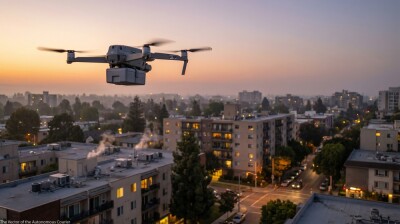
The first is the increasing level of automation and artificial intelligence integration in UAS operations. As drones become more autonomous and capable of learning and adapting in real-time, the regulatory challenge shifts from certifying static systems to evaluating dynamic ones. How do you create safety standards for evolving systems? The answer won't come from regulators alone or industry alone, but rather from both sides working together to develop testing protocols, performance standards, and monitoring frameworks that can keep pace with the technology.
The second area is conspicuity and airspace integration, making UAS and crewed aviation visible to each other within the same airspace. "The technologies for making UAS and manned aviation conspicuous within the same airspace will benefit from close collaboration between EASA and industry," agency representatives told CUAV News. "This should also support the implementation of U-space in Europe."
This is a complex challenge that requires coordination among technology providers, aircraft manufacturers, operators, air navigation service providers, and regulators, something that no single entity can solve in isolation.
Perhaps most significantly, EASA is preparing to launch its eSORA service through the Innovative Air Mobility Hub in 2026. This digital platform is designed to "allow industry and member state authorities to quickly develop the necessary SORA for the specific UAS used and intended UAS operations to obtain an operational authorization in a burden-free way." If successful, it could dramatically reduce the time and complexity involved in gaining approvals for new operations, which is exactly the kind of regulatory efficiency that enables innovation rather than constraining it.
The commercial drone industry stands at a crossroads. The technologies being developed today have the potential to transform all existing verticals within the broader industry and even impact new ones. But that potential can only be realized if the regulatory framework evolves alongside the technology, and that evolution only happens through sustained collaboration between public and private sectors.
The tools and mechanisms exist. EASA has built the pathways. Other regulatory bodies around the world are developing similar approaches. Now it's up to private industry to engage early, to understand the proper channels, to participate in advisory processes, and to view regulators as partners – not opponents – in building a sustainable, scalable future for commercial aviation. The most successful companies in this space will likely be the ones who help shape regulation for the years to come.









Comments