

When we think about autonomous, pilotless aviation, the first thing that comes to mind for many is a large jet full of passengers who have grown accustomed to flying without a pilot on board. This might happen in a human generation or two, but a different reality is closer than we think: autonomous cargo.
One of the aspects that stood out from the recent accident involving the UPS MD11 in November of 2025 was that the aircraft was still carrying cargo despite having been retired from carrying passengers nearly 20 years prior, in 2007. This is simply because the aircraft safety requirements for cargo and passengers are very different, which takes us into 2026, when companies around the world are racing to have autonomous platforms ready for long-haul cargo flights decades before passengers will be flown that way.
The global race to define the future of autonomous aerial logistics is no longer confined to Silicon Valley or the traditional aerospace capitals. Emerging players from developing markets are beginning to articulate their own visions, often shaped by different economic realities, regulatory environments, and strategic priorities. Among these new entrants are Pakistan’s Zelta AeroSystems, a company positioning itself not as a conventional drone manufacturer but as an intellectual‑property‑driven aerospace licensor; The AIRO Group from McLean, Virginia; and Elroy Air, the California‑based hybrid‑VTOL cargo aircraft developer now integrated into U.S. federal programs.
Zelta Systems begins from the premise that the future of aerial logistics will not be uniform across geographies. In markets where infrastructure is fragmented, where maritime and inland waterways remain essential arteries of commerce, and where sovereign capability is a political priority, the company argues that a different kind of aircraft and aerospace company is required. This is why Zelta’s flagship concept is an amphibious VTOL cargo aircraft with a hybrid or fuel‑cell‑based powerplant, designed to operate across land, water, and remote environments.

The company’s public materials emphasize long‑range capability, potentially exceeding 1,000 kilometers, and a multi‑source energy architecture that blends fuel‑cell systems, thermal‑to‑electric conversion, and solar‑buffered energy storage. While these claims remain unvalidated in public flight demonstrations, the conceptual direction is clear: Zelta is targeting markets where range, autonomy, and environmental versatility matter more than certification‑grade refinement or high‑volume production.
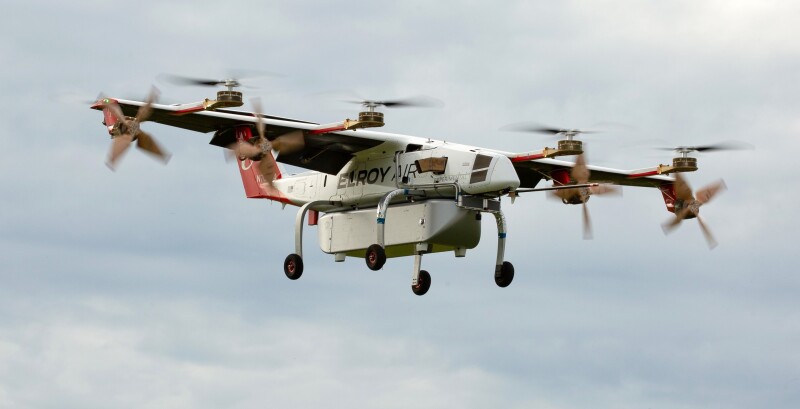
Elroy Air, by contrast, is building for the industrialized world’s middle‑mile logistics networks. Its Chaparral aircraft is a hybrid‑electric VTOL cargo drone with a range of roughly 300 miles and a payload capacity of around 300 pounds. The aircraft is designed to integrate into existing supply chains, serving offshore energy platforms, defense logistics, and commercial freight corridors.
Elroy’s strategy is deeply intertwined with U.S. regulatory and institutional frameworks. The company has been selected for a White House‑backed autonomous cargo integration program, collaborates with the Department of Defense, and is actively pursuing FAA engagement. Its aircraft is not a conceptual platform but a certifiable product, engineered through a traditional aerospace development cycle with clear milestones, documented testing, and a path toward operational deployment planned for late 2026.
The AIRO Group’s platform, on the other hand, is being positioned as a heavy‑lift, dual‑use VTOL optimized for both defense/government ISR missions and commercial cargo/logistics roles. The company publicly unveiled a full‑scale configuration at XPONENTIAL 2026 and described a slowed‑rotor compound (SRC) hybrid‑electric architecture that combines vertical lift capability with efficient forward flight to extend range and endurance. The design emphasizes modularity, notably detachable cargo pods for rapid loading/unloading and mission reconfiguration, which signals a focus on operational flexibility across government and commercial customers.
The AIRO Group’s program materials and industry coverage report ambitious performance targets in ISR configuration, over 1,000 miles of range and roughly 16 hours of endurance, figures that reflect the platform’s emphasis on long‑endurance missions rather than short urban hops. Technically, the hybrid‑electric powerplant is described as the enabler for extended range: an internal combustion or turbine‑based energy source paired with electric propulsion and energy buffering to reconcile VTOL power demands with cruise efficiency.
These contrasting market approaches shape everything that follows. Zelta’s target customers are not logistics giants or federal agencies but sovereign partners, industrial conglomerates, and regional operators in developing markets who seek local manufacturing capability and technological independence. The company’s messaging repeatedly emphasizes territorial licensing, technology transfer, and the creation of indigenous aerospace capacity, a model more reminiscent of Turkey’s Baykar, the UAE’s EDGE Group, or China’s AVIC than of Western eVTOL startups.
It is a strategy built around geopolitical realities in which many countries want advanced aerospace systems but cannot rely on U.S. or European suppliers due to export controls, cost barriers, or strategic autonomy concerns. Zelta is positioning itself as a provider of the underlying architecture, designs, energy systems, and platform concepts, rather than as a vertically integrated manufacturer.
Elroy Air’s commercialization approach is the opposite: an OEM in the classical sense, developing a proprietary aircraft, controlling its production, and integrating it into regulated airspace. Its value proposition is tied to reliability, certification, and the ability to operate within the world’s most demanding aviation ecosystems. The company’s hybrid powertrain is engineered for certifiability, its autonomy stack is designed for regulatory acceptance, and its operational model depends on partnerships with logistics providers who require predictable, repeatable performance. Elroy is not interested in licensing its technology but in building a fleet.
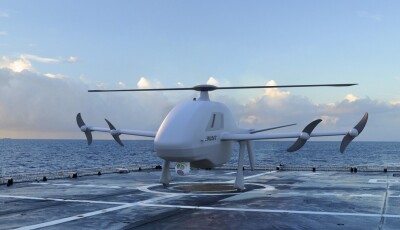
The AIRO Group’s business model is a similar classic OEM commercialization strategy focused on dual‑use heavy‑lift VTOL platforms: it sells aircraft and integrated systems to commercial and government customers while pursuing program‑level partnerships, modular payload sales, and phased operational deployments beginning in 2027.
These three different business models reflect equally divergent technical philosophies. Zelta’s technical narrative is centered on energy innovation rather than airframe maturity. The company publicly showcases prototype‑level demonstrations of Stirling engine–based thermal‑to‑electric conversion, thermoelectric micro‑CHP systems (Combined Heat and Power), and solar‑buffered pulse‑load management. These are not aircraft prototypes but energy‑system prototypes, suggesting that Zelta sees propulsion architecture as the core differentiator.
The amphibious VTOL concept, with its long‑range aspirations, implies a design where VTOL is used sparingly and cruise efficiency dominates the mission profile. The hybrid or fuel‑cell system is intended to overcome the energy‑density limitations that constrain battery‑electric VTOL aircraft. While the company has not released detailed aerodynamic or structural specifications, the emphasis on multi‑environment operations and sovereign adaptability suggests a platform optimized for ruggedness and flexibility rather than certification‑grade refinement.
Elroy Air’s and The AIRO Group's technical approach is far more conventional in aerospace terms. The Chaparral and both JC250 and JX250 use a hybrid‑electric powertrain where a combustion engine drives a generator that charges batteries, feeding distributed electric propulsion. This architecture is well understood, certifiable, and optimized for the middle‑mile mission profile. The aircraft’s lift‑plus‑cruise configuration minimizes VTOL energy consumption, and its autonomous systems—ranging from lidar‑based taxiing to automated cargo pod swapping- are designed for integration into industrial logistics workflows.
Both these companies' engineering choices reflect a philosophy of incremental innovation: to use hybrid power to extend range beyond battery‑electric limits, to use autonomy to reduce operational costs, and finally to use a modular cargo system to streamline logistics. These companies are not trying to redefine the physics of flight, but instead are trying to industrialize a practical, certifiable aircraft and, of course, competing to be first-to-market.
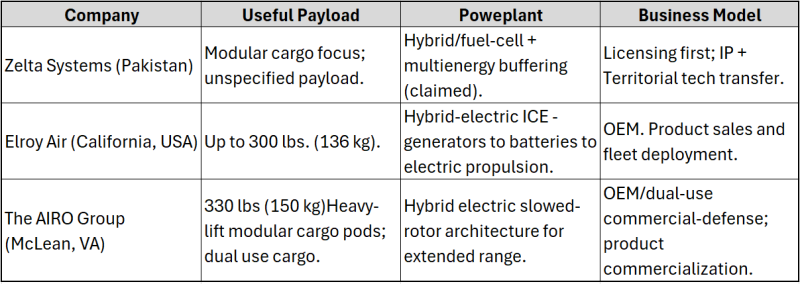
Ultimately, the comparison between Zelta Systems, The AIRO Group, and Elroy Air is a clear contrast between fundamentally different visions of how autonomous cargo aviation will evolve. Elroy and The AIRO Group represent the Western, certification‑driven, OEM‑centric model aimed at integrating autonomous aircraft into existing logistics networks. Zelta represents an emerging‑market, licensing‑driven model aimed at enabling sovereign capability and addressing environments where amphibious operations, long range, and energy flexibility are more important than regulatory conformity.
All three approaches are valid, but they serve different worlds. Elroy and The AIRO Group are building aircraft that will operate in the regulated skies of the United States and Europe. Zelta is designing an aircraft that might operate in the unregulated waterways, remote regions, and sovereign industrial corridors of the developing world. The future of autonomous cargo aviation is bright and will likely include both approaches and many more players than the current status quo of two dominant brands, Boeing and Airbus, with over 90 percent of the market.
The democratization of uncrewed aviation will be felt first through cargo, non-traditional aircraft, and eventually, these experiences will be translated into the realm of passenger flights. The next two years will be crucial in determining how fast this future will arrive and how impactful it will be.












Comments