

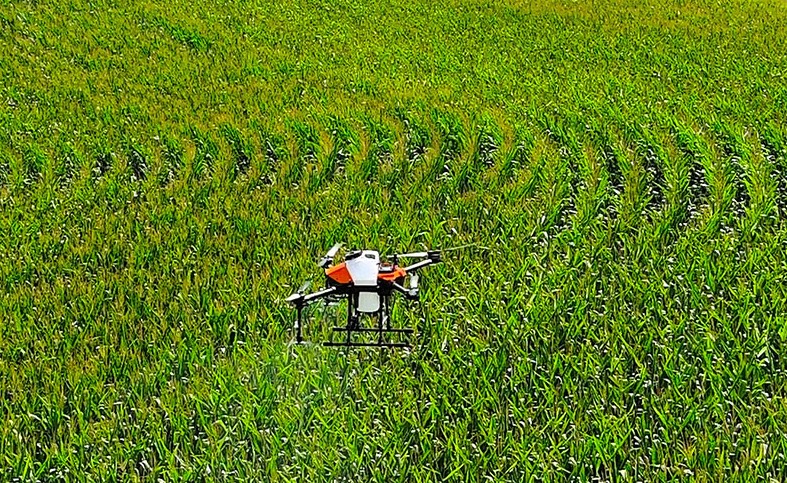
Tall crops such as corn, sorghum, and wheat are grown in huge quantities and serve many uses in our everyday lives. What happens when these crops pick up a disease and need to be treated, but they’ve grown too tall for ground-based spray treatments? That is where spray drones come to the rescue.
In recent years, agricultural spray drones have transitioned from experimental technology to tools that have proven their value. But it’s not as simple as just getting them in the air. There is a science to spraying effectively and safely.
A leader in American agriculture, HTS Ag has been successfully using spray drones for years now and has taken to educating farmers and drone pilots alike on the best practices for spraying.
Commercial UAV News spoke with Adam Gittins, president of HTS Ag, to learn more.
There are a few driving factors as to why spray drones have gained popularity on large-scale farms. Traditional aerial spraying requires a spray plane to fly over the farm, which is quite costly.
“On average, a spray plane will cost about $15 per acre, and that’s just for the flight. The product it’s distributing is a separate cost. A 2,000-acre farm that gets sprayed twice in a season will run the farmer about $60,000 in application fees alone. At this point, the drone would have paid for itself,” explained Gittins.
In many cases, time is of the essence when a disease breaks out. Labor shortages are causing longer wait times for contracted spray pilots, eating up time that farmers can’t spare. To save the crop, farmers take spraying into their own hands with specialized drones.
Yet, it’s not as simple as putting a drone in the sky, spraying a few laps of a field, and calling it a day. Gittins points to two concerns above all others: spray accuracy, and what untrained operators are doing to the industry's reputation.
Incorrect nozzles, ignoring droplet size, and a messy spray path are all characteristics of a poorly flown operation that results in wasted time and product. The evidence is visible from the air.
"I've got pictures of field after field where they got good application in the middle of the swath, but out on the outside edges the spray didn't get there. They probably didn't gain any benefit from doing it,” said Gittins.
There is also a structural mismatch in who is buying spray drones. On one hand, there are tech-savvy operators who don’t know agronomy. In most cases, this is the younger generation returning to work on a family farm after college. They understand the aircraft, but not agronomy or pesticide application. On the other side are experienced farmers who know chemistry and the crops very well, but don’t know aviation. Both groups have good intentions, but without the right training and education, their actions could be detrimental to the image of the drone industry. Good training needs to meet both groups where they are.
"It's kind of a critical moment for the industry. We've got to get this right, or we could lose the trust — or worse, we could have regulatory burdens far beyond what we're currently dealing with," stated Gittins.
So, what does good training look like? For HTS Ag, spray drone training for agriculture is their bread and butter. The company offers spray drone school, Part 107 test prep, and basic flight training among other drone-related courses. These courses run for two to three days and cover considerably more than just how to fly a drone.
The spray drone school teaches students vital tools like sprayer calibration, droplet size management, chemical label literacy, and personal protective equipment, which for some is an entirely new territory.
Gittins explained that one of their more concrete teaching tools is a strip of moisture-sensitive paper. Small squares of this paper are laid out before spraying to reveal exactly what droplet pattern is hitting the ground. This turns something abstract into concept students can actually measure.
“We don’t just train pilots; we train applicators. We’ve got to have real-world agronomy and application skills to go with it, not just how do you fly the aircraft,” stated Gittins.
HTS Ag maintains a ratio of one instructor per five students during hands-on sessions, which are conducted on working farmland. The approach mirrors how the company operates across the board. Gittins farms 500 acres of his own land, and HTS Ag routinely runs prototypes of the equipment it sells and lets students practice on that land before they begin their own work.
On the equipment side, the company partners with Aerostar Dynamics, a Pennsylvania-based manufacturer who produces NDAA-compliant drones. This partnership was born well before the recent FCC ban in the United States, but it was certainly a proactive choice. The company is a distributor of Aerostar Dynamics
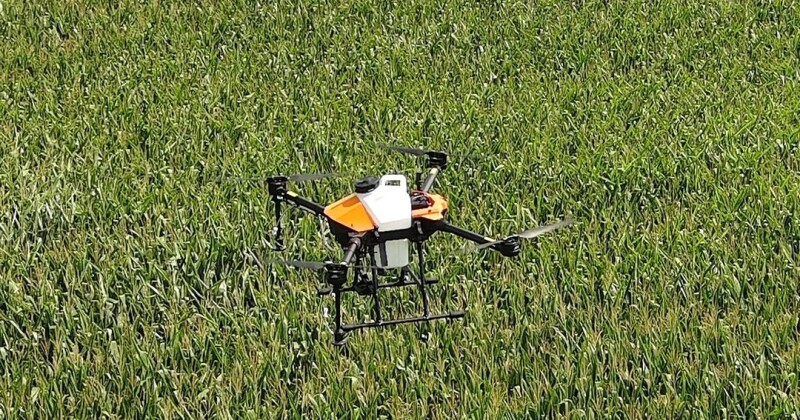
products and is diligent about serving its customers with the appropriate aircraft at a reasonable price.
HTS Ag has grown frustrated with what it describes as overselling in the industry. Spray drone trailers and operator stations running hundreds of thousands of dollars are being marketed to farmers, which are unnecessary for the job. When the economics don't pencil out, those operators end up listing their equipment on Facebook Marketplace, and the industry's credibility takes the hit.
The path forward isn't complicated, but it requires discipline from dealers, trainers, and operators alike. Set realistic expectations, provide real training, and deliver consistent results.
"Spray drones are either going to get regulated out of use, or we're going to have to get to some type of training and compliance — because we're on a path that's not sustainable," warned Gittins.
Adoption is accelerating and the technology is ready. Whether the industry surrounding it is prepared is still an open question — and the answer depends almost entirely on decisions being made right now, at the dealer level, in the training room, and in the field. For HTS Ag, that answer starts with education.







Comments