

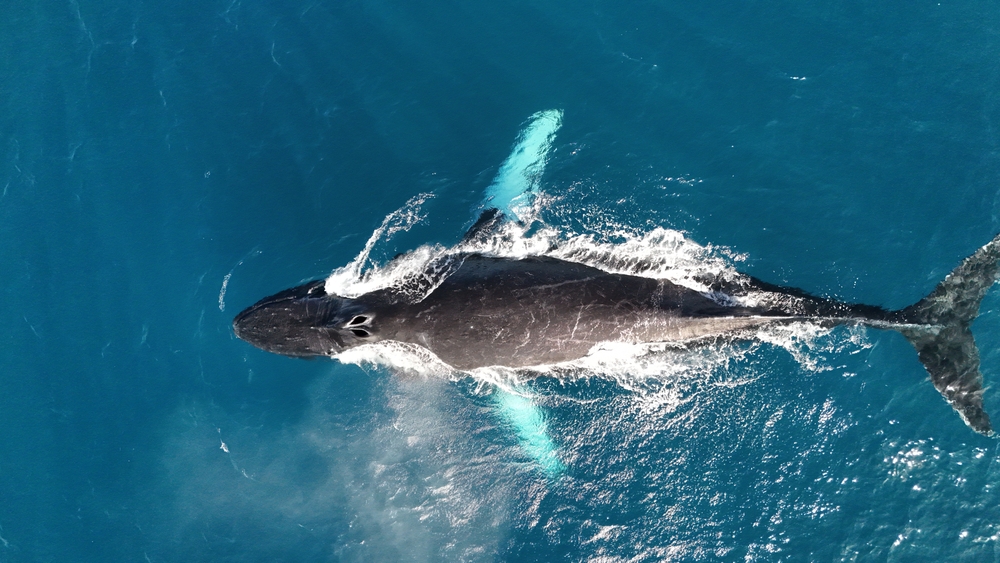
For this week’s round-up of commercial drone industry news, we take a look at how drones are aiding in researching and diagnosing viruses in whales, how Japan is using drones for aerial surveying, and a warning from LifeFlight of Maine to keep drones out of their airspace.
Drones Aid in Whale Virus Diagnosis
According to R&D World, a new fatal virus has been diagnosed among whales in the arctic circle, thanks to a new and non-invasive testing using drones. “Traditionally, skin biopsies are used to test whales for pathogens, which leaves a small wound on the animal,” according to the author. “Using drones to test the air expelled through the blowhole is a less invasive method.”
The drones hover over whales that breach the water’s surface and collect samples from the whale’s blow. The drones are equipped with petri dishes and have been collecting samples from 2016 – 2025. This research has shown that a virus has been circulating in northern ecosystems.
Japan Turns to Drones for Aerial Surveying
In order to safely and efficiently survey the mountainous terrain of Japan, a Wingcopter 198 drone will be flying to collect data to prepare for natural disasters. Through collaboration between Wingcopter, YellowScan Japan Co., Ltd., PASCO Corporation, and ITOCHU Corporation, the fixed wing drones will be deployed in geographically volatile areas. The main functions of the flights will be to create hazard maps and monitor ground deformation, assess damages after a disaster, and measure terrain changes post disaster. YellowScan’s VOYAGER will be the lidar scanner used for this effort. A 45-minute flight will scan 1,000+ hectares while capturing lidar and RGB data.
LifeFlight of Maine Warns about Drone Interference
Following many close encounters over the last year, LifeFlight of Maine has issued a warning to the public of the dangers of flying drones in the airspaces near the hospitals they serve. LifeFlight of Maine is a nonprofit air ambulance service that serves major hospitals in the state. A collision between one of their helicopters or airplanes with a drone can be catastrophic.
“LifeFlight officials say it can be difficult for pilots to see and avoid drones, especially during emergency flights. A collision at flight speeds, which can be up to 165 miles per hour, can be fatal.” A LifeFlight nurse stated that they have seen drones around helipads of three of the state’s major hospitals, sometimes hovering directly over the helipad. According to the FAA’s rules, the penalties for these drone operators can be severe.











Comments