
During World War II, Argentina became one of the principal suppliers of agricultural products to Britain and its allies. In December 1944, British Foreign Secretary Anthony Eden explained to his counterpart in the United States that Britain could not reduce its Argentine purchases because they were essential to the war effort and to maintaining the British economy. He also noted that Britain's dependence on Argentine supplies had intensified during the war.
Before the war, Argentina had become a major agricultural exporter, supported by the fertile Pampas, large-scale cattle production, railways connecting the interior to Atlantic ports, and long-established commercial ties with Britain.
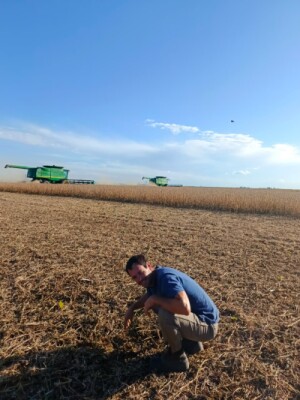
During a recent trip to Argentina, I met with a friend, Kevin McCormick, an Argentinian agronomist who works for a large agricultural concern in La Pampa. He told me about the extensive use of drones in his daily job.
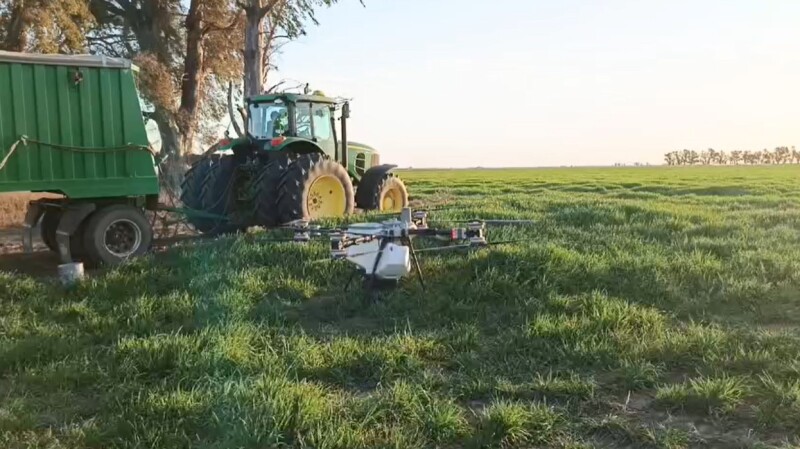
“We use a DJI T100 to spray and seed,” McCormick said. “For years we used traditional aviation for all our crops, but now that drones are available, we can be more selective and decide which fields are to be worked with which technology.”
According to the company that provides Kevin with drone services, a DJI T100 can cover about 15 acres per battery, and during that time, the effect below the drone is about 32 feet wide for pesticides and 36 feet wide for seeding and fertilizing.
The country’s National Institute of Agricultural Technology (INTA) acknowledged the information gap in July 2026 by launching a national survey to provide a clearer picture of drone adoption in agricultural production. The initiative was designed to gather information from farmers, equipment owners, agricultural drone service providers, technology companies, suppliers, and research organizations. According to INTA, no public, systematic dataset existed at the time to measure adoption across Argentina’s agricultural sector. The survey aims to estimate the size of the operating fleet and identify regional and crop-based differences in usage.
“The use of drones has allowed us to save a lot of money by giving us the option of using traditional aviation in those large fields that are close to the airport and then use drones for everything else,” McCormick told Commercial UAV News. “This is particularly important in areas where our neighbors have sensitive crops that could be adversely affected by our spray drift, which is greatly reduced and almost nonexistent when drones are flying low.”
For crop monitoring, drones carry conventional, multispectral, or thermal cameras to collect detailed field imagery. After processing into maps and vegetation indices, this data can help identify differences in crop vigor, detect potential water stress, and direct attention to areas that need closer inspection.
“Our service provider uses one specialized mapping drone for the preparation flights, in which it will be determined if the entire field needs application, or we can save chemicals and time by spraying only specific areas," McCormick said.
Nevertheless, drones are only one part of precision agriculture. Satellite imagery, sensors mounted on agricultural machinery, and other monitoring technologies also contribute to crop-management decisions. Argentina widely uses GNSS on agricultural machinery to map large fields to less than an inch of precision and save water, pesticides, and seeds.
These benefits are not automatic. Application quality depends on factors such as droplet size, wind, flight height, operating speed, and the interaction between the aircraft’s downwash and the crop canopy. Product labels, environmental requirements, and applicable agricultural and aviation rules also remain important. Drone application must be assessed on its operational performance, not simply on the assumption that a smaller aircraft is inherently more precise.
For Argentina, with its extensive field-crop operations, the economic question is whether drone application can perform particular jobs efficiently enough to justify its cost. That calculation will vary with crop type, field size, terrain, weather, labor availability, and whether the farmer owns the aircraft or hires a specialized contractor. In McCormick's employer's case, the company hires the service and does not own drones.
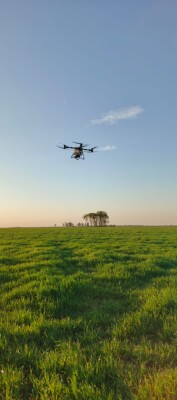
“Right now, we are at the beginning of our planting season, and we have fields for wheat, soy, and peanuts," he said. “It’s a very hectic period in our yearly cycle, and drones are helping us expedite the process by allowing us to concentrate the seeding in smaller patches without drifting to the neighboring farms.”
The opportunities are not limited to soybean, maize, and wheat production in the Pampas. Drone-based monitoring can also apply to orchards, vineyards, olive groves, tobacco, forestry, and other production systems where crop condition and localized variability matter.
In San Juan, for example, researchers associated with CONICET’s INAUT institute and INTA have reported work combining thermal and multispectral imagery to monitor water stress in super-intensive olive groves. Such research shows how aerial sensing can help growers investigate irrigation and plant-water conditions more locally.
These applications also highlight an important market characteristic: the most useful drone configuration depends on the job. A lightweight aircraft carrying a multispectral camera, a heavy-lift spraying drone, and a seed-spreading platform are different tools with different costs, payloads, and operating requirements.
Argentina has also updated its civil aviation framework. In August 2025, the National Civil Aviation Administration, ANAC, adopted Resolution 550/2025, establishing a revised framework under the Argentine Civil Aviation Regulations, or RAAC, Parts 100, 101, and 102.
The framework organizes remotely piloted aircraft operations into three broad categories: open, specific, and certified. The applicable requirements depend on the nature of the operation and its risk. The new rules treat rural operations differently, but they do not eliminate operators’ responsibility for safe flight or the need to respect applicable airspace restrictions. Certain operations, including those beyond visual line of sight (BVLOS) or involving other specified risk factors, require additional authorization.
The revised framework matters for agriculture because operational flexibility, aircraft weight, flight location, and the nature of the work can affect which rules apply. Commercial operators should consult ANAC’s current guidance rather than assume every agricultural mission falls under the same category.
Argentina has documented agricultural drone applications, field experiments, and a regulatory framework intended to accommodate a wider range of operations. What remains uncertain is the scale of commercial adoption.
A credible national assessment needs to distinguish the number of aircraft from the number of active operators, hectares treated from hectares surveyed, and privately owned equipment from contracted services. It should also measure how activity differs by crop, region, and season. INTA’s national survey results could provide an essential foundation for that analysis, although the sources reviewed did not identify a published final national dataset.
For manufacturers, distributors, agricultural service companies, and investors, those figures would help determine where demand is concentrated and which applications have moved beyond experimentation into routine farm operations. For farmers, they could provide a better basis for comparing costs and benefits with conventional machinery and other precision-agriculture tools.
Argentina’s agricultural drone story is therefore more substantial than a collection of technology demonstrations, but its full dimensions remain difficult to quantify. The technology is being applied to real agricultural problems, from crop monitoring to aerial seeding. The next step is to establish, with reliable national evidence, how widely those capabilities are used and where they deliver measurable value.
In the meantime, Kevin is back at work as the planting season is in full swing, and the time he could give me for more details ran out. It is rewarding to see our industry making a real difference with real people in real workflows.







Comments