
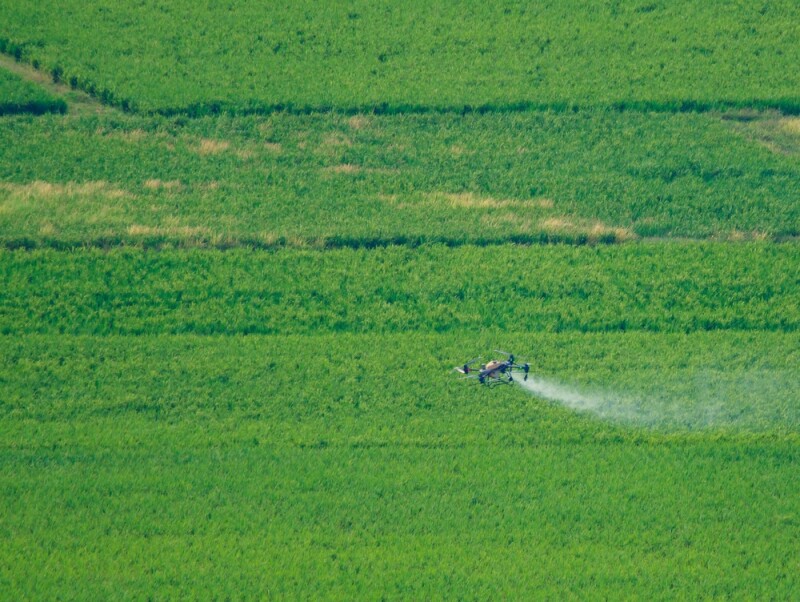
In commercial UAV spraying, procurement discussions are still dominated by platform specifications, such as payload capacity, flight time, range, and automation features. While these factors matter, field evidence increasingly shows that nozzle selection and spray system configuration have a greater influence on return on investment (ROI) than the drone itself.
Across multiple agricultural UAV deployments and controlled field trials, nozzle choice consistently emerged as the most underappreciated variable shaping operational efficiency, environmental performance, and economic viability.
The Platform Fallacy in UAV Spraying
Most UAV buyers evaluate platforms as standalone assets. In reality, spraying outcomes are produced by a spray system, not a drone alone.
Two operators flying identical platforms can produce dramatically different results depending on:
- Nozzle geometry
- Droplet size distribution
- Flow rate control
- Compatibility with crop canopy structure
Yet nozzle selection is often treated as a post-purchase accessory rather than a core design decision. This misalignment has direct financial consequences.
Nozzle Geometry and Deposition Efficiency
Field-level comparisons between commonly used UAV spray nozzles show substantial variation in deposition uniformity, even under identical flight parameters.
Certain ultra-low-volume (ULV) nozzle configurations improved canopy deposition by 20-35 percent, particularly in dense or multi-layered canopies such as orchards and tall crops. These gains translated into:
- Reduced chemical requirement per hectare
- Lower need for repeat applications
- More consistent agronomic outcomes
In contrast, suboptimal nozzle designs led to uneven droplet distribution, increased runoff, and localized under-application – forcing operators to compensate through higher chemical loads or additional passes.
From a commercial standpoint, every corrective flight directly erodes margins.
Drift, Speed, and the Cost of Over-Optimization
Many operators attempt to maximize productivity by increasing flight speed. However, nozzle performance is tightly coupled to airspeed and rotor-induced airflow.
Field observations revealed that:
- Drift risk increases non-linearly beyond certain speed thresholds
- Fine-droplet nozzles are particularly sensitive to speed variation
- Drift losses can offset 15-25 percent of expected chemical savings
When drift occurs, ROI is impacted twice, first through wasted inputs, and second through potential compliance and reputational risks.
This highlights a critical insight: speed optimization without nozzle matching is false efficiency.
Energy Use and Mission Economics
Nozzle choice also affects energy efficiency, though this is rarely discussed.
Higher flow-rate nozzles require:
- Larger payload volumes
- Increased takeoff weight
- More frequent battery swaps
These factors increase energy consumption per hectare and reduce operational throughput. In contrast, optimized ULV nozzles enabled:
- Fewer flight cycles
- Better payload utilization
- Lower energy intensity per mission
Over an entire spraying season, these differences compound into significant cost differentials – often exceeding the price gap between drone platforms.
ROI Is Parameter-Driven, Not Hardware-Driven
From a business perspective, ROI in UAV spraying is shaped less by platform capability and more by parameter alignment:
- Nozzle type matched to crop architecture
- Flow rate calibrated to canopy density
- Speed and altitude tuned to droplet behavior
Operators who invested time in spray system optimization consistently achieved:
- Lower input costs per hectare
- Higher mission repeatability
- Reduced operational variability
Those who did not were forced into reactive corrections that undermined profitability.
Implications for Commercial UAV Buyers and Operators
For buyers, this means procurement decisions should extend beyond platform brochures. Spray system compatibility, nozzle testing data, and calibration support should be treated as core evaluation criteria.
For service providers, nozzle-level experimentation and documentation are not academic exercises, but rather commercial necessities. The ability to justify parameter choices with data increasingly differentiates professional operators from commodity service providers.
Rethinking Value in UAV Spraying
As the agricultural UAV sector matures, competitive advantage will shift away from hardware differentiation toward operational intelligence. Nozzle selection is a small component with outsized impact – a reminder that in commercial UAV spraying, precision is not optional; it is the business model.
The drones may fly, but the nozzles decide whether the operation pays off.








Comments