

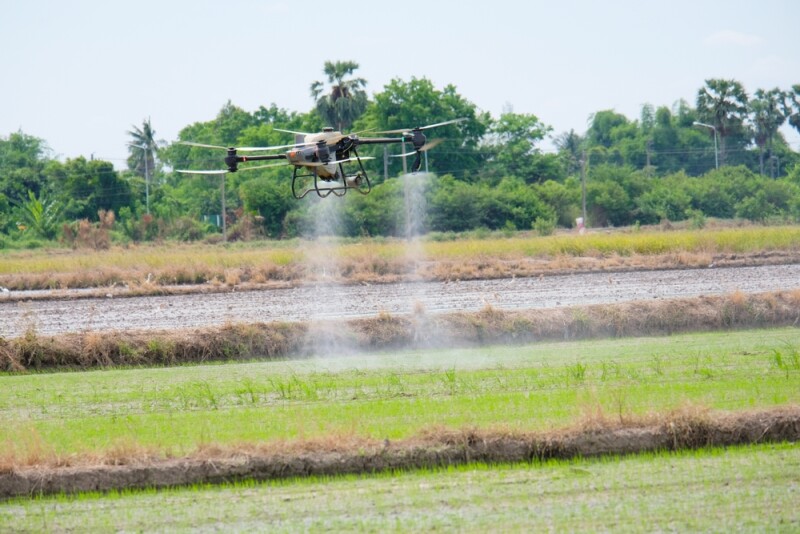
Commercial UAVs are most often framed as delivery systems – platforms designed to move inputs efficiently from tank to canopy. While this framing has helped drive adoption, it also limits how value is understood and captured. Field evidence increasingly shows that the long-term impact of agricultural UAVs lies not in spraying alone, but in how data transforms these systems into decision-support tools for climate-smart agriculture.
The transition from hardware-centric deployment to data-driven operations marks a critical inflection point for the commercial UAV sector.
UAVs as Data Generators, Not Just Applicators
Every UAV spraying mission generates rich operational data:
- Flight parameters
- Nozzle configurations
- Environmental conditions
- Application outcomes
Yet in many commercial deployments, this data remains underutilized. Spraying decisions are often based on heuristics, default settings, or vendor recommendations rather than evidence derived from previous missions.
When operational data is systematically captured and analyzed, UAVs shift from being mechanical tools to adaptive systems capable of learning and improving over time.
Machine Learning and Parameter Optimization
Field-level studies combining spraying performance data with machine learning models revealed strong non-linear relationships between operational parameters and efficiency outcomes.
Models integrating:
- Flight speed and altitude
- Nozzle type and flow rate
- Crop canopy structure
- Weather variables
were able to predict configurations that minimized water use, chemical input, and energy consumption while maintaining agronomic efficacy.
This approach replaces trial-and-error optimization with predictive decision support, allowing operators to select mission parameters before takeoff rather than correcting inefficiencies after the fact.
Climate Intelligence Emerges at the Operational Scale
Climate-smart agriculture is often discussed at policy or landscape scales. UAV data enables climate intelligence to emerge at the operational level, where daily decisions are made.
By integrating life cycle indicators – such as water use per hectare, chemical efficiency, and carbon intensity – into UAV operations, it becomes possible to:
- Quantify environmental trade-offs in real time
- Align spraying strategies with climate adaptation goals
- Support evidence-based reporting for sustainability frameworks
In this context, UAVs act as sensing and decision nodes within a broader agro-climatic system.
Why Decision Support Matters Commercially
From a business standpoint, decision-support capability directly affects:
- Operational repeatability
- Cost predictability
- Regulatory compliance
- Market differentiation
Operators who rely solely on hardware performance are vulnerable to variability caused by weather, crop differences, and terrain. Those who integrate data-driven decision frameworks build resilience into their operations, reducing risk and improving consistency.
As sustainability reporting requirements grow, the ability to demonstrate how decisions were made becomes as important as the outcomes themselves.
Bridging Technology and Human Systems
Data alone does not guarantee better outcomes. Field observations consistently show that training quality, workflow integration, and institutional support determine whether decision-support tools are effectively used.
For UAV-based decision systems to deliver value, operators must be empowered to interpret insights and adapt practices accordingly. This human–technology interface is often overlooked, yet it remains central to successful scaling.
Redefining the Value Proposition of Commercial UAVs
The next phase of commercial UAV adoption will not be driven by marginal improvements in flight time or payload. It will be shaped by how intelligently data is integrated into operational decision-making.
When UAVs evolve from applicators to climate-aware decision tools, they offer value that extends beyond efficiency – supporting sustainability, resilience, and accountability across agricultural systems.
The future of agri-UAS will belong to those who do more than deploy drones. It will belong to those who use data to decide.









Comments