

Contributed by Andrew Kobza, founder & CEO, Professional Drone Solutions
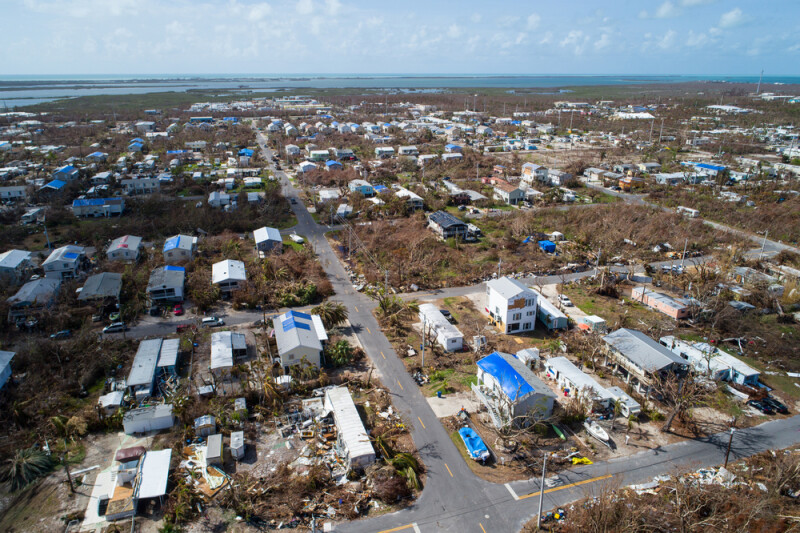
Hurricane Irma made landfall at Marco Island on September 10, 2017. In the two weeks after it passed, our company flew 250 roof inspections across Southwest Florida. That is roughly 18 roofs a day, every day, for a company that was two years old.
The flying held up. Most of what broke happened after the drone landed. Here is what went wrong, what we changed, and what we would tell an operator planning for the next surge.
Why the Pace was Possible At All
The pace came from not climbing. After a hurricane, a roof is the last place you want a person. Decking can be soaked and soft, tiles loose, and membranes lifted and hidden under standing water. A pilot on the ground can read every slope from the air, and nobody has to find out the hard way which part of the roof is no longer holding.
Every roof we didn't have to walk was time we got back and a risk nobody had to take. That is the real case for drones work in surge. It is a safety argument first and a speed argument second.
What Broke
The Handoff
We delivered the way most operators did then: a folder of photos per property, sent as a download link. For the person on the other end, that folder was hard to use. It held hundreds of images with camera file names, no sense of which slope each photo showed, and no easy way to send one damaged area to a roofer without forwarding the whole set.
An owner, a property manager, a roofer, and an adjuster all needed the same evidence, and each of them had to dig through it on their own. We finished the inspection, and their work of making sense of it had only just begun.
Nothing to Compare Against
The claims that moved fastest had a record of the roof from before the storm. Most roofs had none.
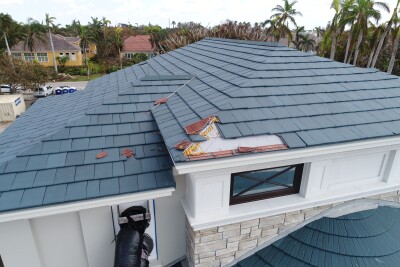
Post-storm images prove that damage exists. They don't prove the storm caused it. Roofs wear, and a carrier can fairly ask whether a cracked tile or a lifted edge was already there. We could show exactly what a roof looked like a few days after Irma. We could not show what it looked like a month before, and that was the question that kept coming back.
Consistency Over Two Weeks
At 18 roofs a day, the risk is that roof 200 gets a thinner set than roof 20. We were flying to a checklist our pilots carried in their heads, and that kind of checklist wears down by the second week. Coverage depended too much on judgment at the end of a long day.
What We Changed
A fixed shot list. Every roof now gets the same sequence: every slope, a wide frame that places the roof on the property, and close passes over anything that looks wrong, close enough to read individual tiles or seams. The order doesn't change between pilots or visits, so you can compare any set with the next one.
Dated, located images, organized by property. Every image keeps when it was taken and where the drone was. We organize by property and position, not by camera file name, from the first flight of the day.
One link per property. The owner, the roofer, and the adjuster open the same set, with each photo placed where it was taken. We eventually wrote our own software for this in 2019, but the principle matters more than the tool. Plan delivery for the least technical person who will open it, and nothing should need to be installed.
Baselines before the season. We now encourage owners, boards, and property managers to fly a dated record before storm season, from the same positions we would use afterward. When a storm comes through, the before-and-after lineup and the comparison do most of the arguing.
What Has Changed Since 2017
Since Irma, we have flown more than 1,500 inspections. After Hurricane Ian in 2022, we mapped communities across Southwest Florida, and the difference in how that work went came almost entirely from the changes above, not from better aircraft.
The aircraft did get better. Cameras resolve more detail from a safer distance, batteries last longer, and positioning is more reliable. Those gains are real, but none of them would have fixed a folder of unlabeled photos or a roof with no before record.
The bigger shift is in who receives the work. Owners and managers increasingly expect to open a record in a browser and share it, and boards with many buildings think about inspections as a program rather than a one-off. That changes what operators must deliver.
1.JPG.small.400x400.jpg)
Advice For Operators Planning Surge Work
1. Write the shot list before the storm. Day one after landfall is not the time to decide what "complete" means. Make it short enough to follow at the end of a long day.
2. Organize from the first flight. Sorting a few thousand images by property after the fact costs more time than the flying did.
3. Design the delivery for the reader. If an adjuster can't find the damaged slope in under a minute, the inspection isn't finished.
4. Sell the baseline in the off-season. A dated pre-storm record is the single most useful thing an owner can have when a claim is questioned, and it is easy to fly when nobody is in a hurry.
5. Check airspace every day. After a major storm, temporary flight restrictions go up around response and recovery operations. Check before every flight and stay clear of crewed aircraft doing rescue and utility work.
6. Plan for the grind. Two weeks of 18 roofs a day is an endurance problem as much as a flying problem. Build in rest, rotate tasks, and protect the quality of the last flight of the day.
Irma taught us that the flight is the easy part. The value is in a record someone else can open, trust, and act on, and the time to build that is before the next storm, not during it.













Comments