
Sponsored by YellowScan
Aerial surveying has come a long way over the last decade-plus, particularly when it comes to UAV-based lidar surveys. Thanks to big leaps made in lidar technology, these systems have shrunk to the point, without sacrificing power, that longer-range surveys are possible with this technology, allowing for cheaper operations in most cases. One of the big pain points that remains in this space, however, is mapping environments that straddle land and water.
For a long time, surveyors have had to choose between two incomplete datasets, relying on topographic lidar that stops at the waterline and boat-mounted sensors that can’t access shallow areas near the shore, resulting in gaps in areas where that data may be most valuable. With incomplete data where the land and water meet, erosion can go under-detected, ecological habitats can go unmapped, and river floodplain mapping is lacking accuracy.
The good news is that technology is catching up to this problem. As lidar systems overall improve, we are now seeing more systems that are built for topo-bathymetric surveying, combining different systems and capabilities into a single system.
Although today much of this innovation is limited to systems built for crewed aircraft, YellowScan’s Navigator solves this exact issue for UAV-based surveying. The system uses a green laser to simultaneously capture both above-ground topography and underwater bathymetry in a single flight, producing a unified dataset without requiring any merging of separate data sources. Operating at up to 100 meters AGL with 3 cm precision and accuracy, the Navigator weighs just 3.7 kg and offers 45 minutes of flight autonomy, making it deployable on a wide range of multirotor and helicopter UAV platforms.

One of the most compelling applications for a system like the Navigator is river mapping, where the challenges of traditional survey methods are most apparent. Wading transects work well in accessible, calm water, but fall short in wooded or rugged environments, deep pools, and fast-moving currents. Boat-mounted echo sounders face similar limitations, and integrating that bathymetric data with separately collected topographic data is time-consuming and often produces discontinuities at the land/water boundary.
YellowScan Navigator addresses all of these pain points in a single deployment. Flying at low altitude, the system can map a 300-meter stretch of river with 50 meters of bank on either side in just 10 minutes, with data processing taking less than two hours. The result is a unified digital terrain model that integrates terrestrial and subaquatic data, without the need for merging two different models, with point densities of 20 to 50 points per square meter at the riverbed. The system's ability to penetrate vegetation cover also ensures data continuity between the wet bed and wooded banks, making it particularly valuable for river mobility studies, erosion monitoring, and floodplain modeling.
The coastal erosion use case is where the Navigator's land-to-water continuity becomes especially critical, and a project on Sweden's southern Baltic coast illustrates that well. The Ystad Municipality has long run a coastal monitoring program tracking shoreline movement and underwater topography, but shallow and turbulent nearshore conditions made it difficult to collect bottom topography data with sufficient resolution using boat-mounted sensors.
Working with drone services firm VisionAir Production, the municipality deployed YellowScan Navigator for what was the first aerial bathymetric lidar survey in Sweden. By pairing Navigator data with topographic lidar collected over land, VisionAir created a seamless dataset extending from six meters below the water surface to 100 meters inland across approximately 550 hectares of coastline, more than double the area mapped in previous years.
The data revealed clear erosion hotspots and identified a westward shift in sediment movement that hadn't shown up in earlier surveys. The municipality was convinced enough by the results to extend VisionAir's contract for three years. As VisionAir Co-founder and COO Jonathan Rybo put it, "Being able to seamlessly stitch underwater bathymetric data with land topography data is nothing short of magical."
Perhaps the most forward-looking application of the Navigator to date comes from Norway, where the Norwegian Institute for Water Research (NIVA) deployed the system as part of SeaBee, the country's drone-based coastal research and monitoring infrastructure. The goal was to produce a 3D model of a submerged seagrass bed — an ecosystem that captures and stores significant amounts of CO2 — in order to quantify the carbon stored in above-ground biomass. Traditional monitoring methods simply lacked the resolution needed to do this in shallow, dynamic coastal waters.
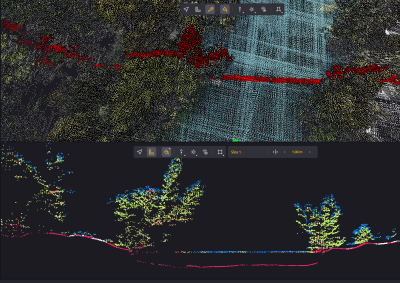
Flying at both 25 and 50 meters AGL, the Navigator delivered point densities of 125 and 70 points per square meter, respectively, with horizontal and vertical accuracies between one and 1.5 centimeters. Using CloudStation's terrain classification tools, NIVA researchers separated the raw point cloud into land, water surface, water column noise, and seafloor, then used a Random Forest model to distinguish seagrass vegetation from true seabed.
The workflow produced high-resolution digital surface and terrain models at 10 cm resolution, and the first canopy height models of submerged seagrass ever generated at that level of detail. Point cloud density came in at roughly an order of magnitude higher than what conventional airborne lidar surveys can achieve. "This system represents the next step forward for shallow water habitat mapping," said NIVA researcher Charles P. Lavin, "facilitating cost-effective, reproducible, and high-resolution results relative to traditional surveying methods."
What YellowScan Navigator and projects like these demonstrate is that the data gap at the land/water boundary is finally a solvable problem. From river floodplains choked with vegetation to turbulent Baltic nearshore zones to submerged seagrass ecosystems storing carbon off the Norwegian coast, UAV-based topo-bathymetric lidar with the Navigator is proving itself across a remarkably wide range of environments and applications.
As coastal erosion accelerates and demand for high-resolution environmental monitoring grows, the ability to survey continuously across that boundary will only become more valuable. The technology is here. The use cases are proven. The question now is how quickly the broader surveying industry moves to adopt it.









Comments