

In 2018, two friends with an engineer’s restlessness and an entrepreneur’s instinct began designing and building a small delivery drone in Scottsdale, Arizona. It was an early attempt to prove that lightweight uncrewed aircraft could move real packages, not just capture video. However, turning a backyard prototype into a commercial operation required more than good aerodynamics. It required a regulatory pathway that would let them fly the routes that mattered. So, they relocated to Brazil, where a more favorable uncrewed aviation environment and a faster‑evolving approval process for operational flights gave them the runway to transform a personal project into what would become Speedbird Aero.
Samuel Salomao, the engineer, and Manoel Coelho, the businessperson, have done the improbable. With just an idea and an insatiable appetite for innovation and change, they have created a drone delivery system that is revolutionizing the way packages and food are delivered in many countries around the world.
Now, they are coming back to the U.S. with proven success and a steely determination to make it happen here too. Commercial UAV News reached out to Andre Stein, board director and president Americas of Speedbird, and Manoel Coelho, co-founder and CEO, for an in-depth view into their plans for North America.
“Samuel and I were working in telemedicine in Arizona in 2015 and 2016, and that’s when the idea of transportation using a drone first came to us,” Manoel said. “That’s how our platform was born. But the regulatory framework in Brazil was more favorable for a sustainable business model, so we decided to relocate. People sometimes forget that Brazil is an aviation country. The city of Sao Paulo has the largest daily helicopter traffic in the world, and we have the second-largest fleet of registered private aircraft, after the U.S. It was a natural place to start the company.”
Speedbird Aero, founded in Brazil in 2018, has become among the most compelling examples of how drone‑delivery innovation can emerge far from traditional aerospace power centers and still achieve global impact. What began as a small team designing lightweight delivery aircraft for short‑range logistics in Brazil has evolved into a multinational operation whose drones now fly in Europe, the Middle East, and Asia. Their trajectory illustrates not only the maturation of drone technology but also the importance of regulatory timing, operational discipline, and strategic partnerships. In many ways, Speedbird’s story is a case study in how a company from an emerging aviation market can influence global norms and demonstrate what scalable drone logistics actually looks like.
“The future of aviation won’t be built in isolation,” said Stein. “It will be built with the right local partners, customers, investors, manufacturing and operational partners, and local governments, working together to identify the right use cases and turn our combined experience into real, scalable value.”
Speedbird’s early success in Brazil was rooted in a combination of technical capability and regulatory opportunity. Brazil’s civil aviation authority, ANAC, embraced a Specific Operations Risk Assessment (SORA)‑based approach to risk assessment earlier than many countries, allowing operators to pursue BVLOS missions under structured, repeatable frameworks.
Speedbird capitalized on this environment by developing its own aircraft, the DLV‑1, DLV‑2, and later the DLV‑4 VTOL, designed specifically for commercial delivery. These aircraft were not hobbyist conversions or off‑the‑shelf platforms, but rather purpose‑built logistics tools with automated route planning, integrated safety systems, and parachute recovery. As a result, Speedbird was able to move quickly from pilot projects to sustained commercial operations.

One of the company’s most influential partnerships emerged with iFood, Brazil’s dominant food‑delivery platform. Beginning in 2021, Speedbird and iFood launched a series of drone‑supported delivery corridors that dramatically reduced travel times in congested or geographically constrained areas. A widely cited example is the Aracaju route, where a 30‑minute road delivery became a three‑minute drone crossing over the Sergipe River. These operations were commercial routes serving real customers, with thousands of flights logged and analyzed. By 2026, Speedbird had completed nearly 40,000 commercial missions across 14 countries, a scale unmatched by most drone‑delivery startups.
The regulatory breakthrough that solidified Speedbird’s leadership came in March 2026, when ANAC approved routine BVLOS flights over densely populated urban areas. This shift, from route‑by‑route approvals to a scalable national framework, allowed Speedbird to operate more like a true logistics network rather than a collection of isolated experiments. It also positioned Brazil as one of the few countries in the world with a mature, nationwide drone‑delivery regulatory structure.
For Speedbird, this meant the ability to expand manufacturing, standardize operations, and attract international partners who saw Brazil as a proving ground for what drone logistics could become elsewhere.
From Brazil to the World
Speedbird’s international expansion reflects a deliberate strategy: Enter countries where regulators are open to structured BVLOS trials and where logistics partners can immediately benefit from aerial corridors. This approach has taken the company to Singapore, Israel, Italy, and the United Kingdom, among others. Each location offers a different operational challenge and a different regulatory culture, giving Speedbird a portfolio of experience that few drone companies can match.
“Speedbird Aero was born in Arizona, and it is returning to the U.S. at a pivotal moment,” said Manoel. “With the regulatory framework for scalable drone logistics finally taking shape and a proven, commercially viable model ready to deploy, we are uniquely positioned to capitalize on this opportunity. We are coming back to the U.S. to start manufacturing here for the local markets, and we are ready to bring a competitive solution to a market that is ready as soon as we have Part 108.”
Regarding their international operations, Singapore represents one of the most tightly regulated airspaces in the world, yet Speedbird secured contracts there by demonstrating reliability and compliance. Israel, with its national drone‑delivery sandbox programs, provided another environment where Speedbird could integrate into a complex, technology‑driven ecosystem. Italy offered opportunities in healthcare logistics, where drones can shorten delivery times for medical supplies in regions with difficult terrain. In each case, Speedbird’s value proposition was the same: a mature, safety‑validated aircraft paired with an operational model that regulators could trust.
But perhaps the most symbolically powerful example of Speedbird’s global reach is found in the United Kingdom, where its aircraft are now delivering mail for one of the world’s oldest and most respected postal institutions.

The Royal Mail Connection
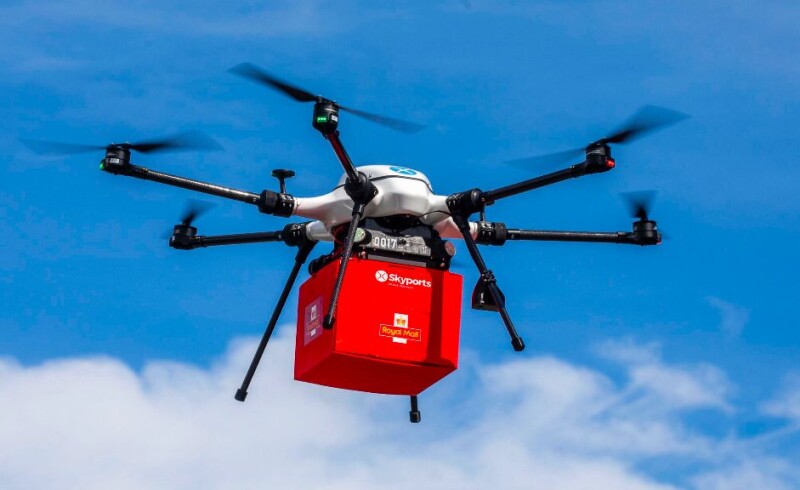
In the Orkney Islands of Scotland, Royal Mail has launched the United Kingdom’s first permanent drone‑delivery service. The operation is managed by Skyports Drone Services, a leading BVLOS operator in the UK, but the aircraft performing the flights are Speedbird Aero’s DLV‑2 drones. While the contract is formally between Royal Mail and Skyports, the operational backbone of the service is a Brazilian‑designed and Brazilian‑manufactured aircraft.
The Orkney operation is a milestone for several reasons. It is a daily, full‑time service rather than a temporary trial. It operates BVLOS with visual mitigation, a regulatory category that requires rigorous safety justification. And it replaces ferry‑dependent inter‑island mail legs that were often delayed by weather, meaning the drones are not simply faster, they are more reliable. The service has already completed hundreds of missions, improving delivery times by as much as a full day in some cases.
For Speedbird, this partnership is a validation of their aircraft in one of the world’s most scrutinized aviation environments. The United Kingdom’s Civil Aviation Authority is known for its conservative approach to emerging technologies, and Royal Mail’s operational standards are exceptionally high. The fact that a Brazilian drone is now part of the UK’s national postal infrastructure underscores how far Speedbird has come and how global the drone‑delivery landscape has become.
A Global Model for Drone Logistics
Speedbird’s rise offers several lessons for the future of drone integration. First, regulatory sequencing matters. Countries that allow structured experimentation early on can become exporters of operational expertise. Second, in‑house aircraft development gives operators control over safety, reliability, and integration, advantages that become critical when scaling internationally. Third, partnerships with established logistics players, whether iFood in Brazil or Royal Mail in the UK, provide credibility and operational depth that pure technology companies often lack.
Most importantly, Speedbird demonstrates that drone logistics are no longer a speculative technology. It is a functioning, commercially viable service operating across continents. The company’s journey from Brazil to Scotland, Israel, Singapore, Italy, and now the U.S., shows that the delayed impact of drones is beginning to accelerate, driven by operators who combine technical rigor with regulatory fluency.










Comments