

On December 9, ResilienX, a Syracuse, New York-based company, announced that its new service, ORION‑X, has selected the city of Detroit as the testbed for the deployment of ORION-X to provide "rapid, cost-effective aerial content" for a local media organization.
This announcement marks a meaningful shift in how drone operations may be delivered, scaled, and integrated into the daily functions of a modern city. While many companies in the uncrewed aviation ecosystem talk about enabling BVLOS operations or building the digital infrastructure for future air mobility, ResilienX has taken a different approach: Operationalizing a drone‑as‑a‑service (DAAS) model that works within today’s regulatory constraints while preparing cities for tomorrow’s autonomous systems. The company’s decision to launch ORION‑X in Detroit is not just a business move but a strategic demonstration of how a shared aerial data service can function as a civic utility.
Detroit’s selection as the inaugural deployment site is no accident. The city has been positioning itself as a hub for advanced mobility innovation, and Michigan Central’s efforts to create an Advanced Aerial Innovation Region provide fertile ground for experimentation. In this environment, ResilienX found a partner willing to test a model that blends technology, policy, and real‑world operational needs. The Detroit deployment is designed to show that drone operations can be reliable, repeatable, and seamlessly integrated into existing workflows, even in a dense urban setting where airspace complexity and public scrutiny are high.
Commercial UAV News reached out to Andrew Carter, co-founder and CEO of ResilienX for comments.
“We’re excited about this engagement as it is strategic for both ResilienX and our partners in Detroit," he said."Think of it like this: ORION-X does for drone operations what cloud infrastructure did for computing. It takes the operational, regulatory, and technical complexity that every organization struggles with and turns it into a shared service where you can use as much or as little as you need. That lets agencies and companies focus on outcomes rather than the burdens of ownership, compliance, or liability. When you remove the need for each group to solve the same problems in isolation, you get dependable, repeatable aerial operations that can scale across regions, use cases, and partners.”

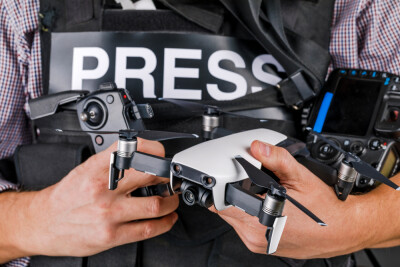
At the heart of ORION‑X is a simple but powerful idea: Organizations should be able to request aerial data the same way they request any other municipal service. Instead of buying drones, training pilots, navigating FAA approvals, or maintaining fleets, customers simply ask for the outcome they need. ORION‑X handles everything else. This outcome‑based model is particularly appealing to sectors that need aerial data frequently but lack the resources or desire to manage aviation operations. In Detroit, the first major adopter is a media organization that requires rapid, high‑quality aerial footage but face logistical and regulatory barriers when trying to capture it with in-house capabilities. By integrating ORION‑X directly into their newsroom workflows, ResilienX is demonstrating how drones can become a natural extension of existing processes rather than a specialized, standalone capability.
The media use case is strategically clever. Newsrooms operate on tight deadlines, and their demand for aerial imagery is both frequent and time‑sensitive. They also represent a relatively low‑risk operational environment compared to emergency services or critical infrastructure inspections. By proving that ORION‑X can reliably deliver for this media outlet, ResilienX builds credibility and operational maturity before expanding into more complex applications. At the same time, the visibility of media work ensures that the public sees drones being used in constructive, transparent ways, which helps build trust in the broader ecosystem.
Beyond media, ORION‑X is designed to serve a wide range of municipal and commercial needs. Public safety agencies can request overwatch for incidents, search‑and‑rescue support, or rapid situational awareness during emergencies. Public works departments can order bridge inspections, right‑of‑way surveys, or storm damage assessments without needing to own or operate any aircraft. Utilities, airports, campuses, and private companies can tap into the same shared service for their own operational needs. In every case, the customer receives the data they need while ORION‑X manages the planning, approvals, flight operations, and analytics.
This model is not entirely new, as several companies have attempted variations of DAAS, but ORION‑X distinguishes itself through its integration of AI, its focus on operational resilience, and its alignment with the emerging regulatory landscape. ResilienX has long been known for its safety and assurance tools, particularly in the context of uncrewed traffic management. ORION‑X builds on that foundation by embedding safety, monitoring, and compliance into every mission. The service is designed to scale from a single neighborhood to an entire region while maintaining consistent standards and governance. This scalability is essential for cities that want to move beyond pilot projects and toward sustained, everyday drone operations.
The Detroit deployment also serves as a real‑world testbed for how cities might prepare for future BVLOS regulations. While the FAA continues to refine the frameworks that will eventually govern autonomous drone operations, companies like ResilienX are demonstrating what can be done today. ORION‑X does not require sweeping regulatory changes to function; instead, it uses existing pathways, waivers, and operational models to deliver value immediately. At the same time, the data, lessons, and operational patterns generated in Detroit will help inform how cities and regulators think about scaling uncrewed aviation. In this sense, ORION‑X is both a practical service and a strategic bridge to the future.
The economic implications are also worth noting. Many cities want to use drones but are deterred by the cost of equipment, training, and compliance. ORION‑X eliminates these barriers by shifting the model from capital expenditure to service subscription. ResilienX claims that this approach can be up to ten times more cost‑effective than owning and operating a fleet. For budget‑constrained municipalities, this is a compelling proposition. It also democratizes access to aerial data, allowing smaller agencies and organizations to benefit from capabilities that were previously out of reach.
Detroit’s role as the launch partner gives the city a chance to shape how this model evolves. By participating early, Detroit can influence the operational standards, data governance practices, and community engagement strategies that will define ORION‑X as it expands. The city also gains early access to a tool that can enhance public safety, improve infrastructure management, and support economic development. For a city that has spent years reinventing itself as a center for innovation, this partnership reinforces its identity as a place where new ideas are tested and refined.
For ResilienX, the launch of ORION‑X represents a maturation of its mission. The company has always focused on safety, resilience, and the digital infrastructure needed for advanced air mobility. With ORION‑X, it is stepping into the operational domain, showing that not only can it build the tools that support drone ecosystems but also deliver the services that make those ecosystems valuable. This dual role positions ResilienX as both a technology provider and a service operator, giving it a unique advantage as the industry evolves.
In the broader context of uncrewed aviation, ORION‑X is a sign that the industry is moving from experimentation to implementation. Cities are no longer content with one‑off demonstrations or short‑term pilot programs. They want sustainable, scalable solutions that integrate into their daily operations. ResilienX’s Detroit deployment is an attempt to meet that demand, offering a model that could be replicated in other cities across the country.










Comments