

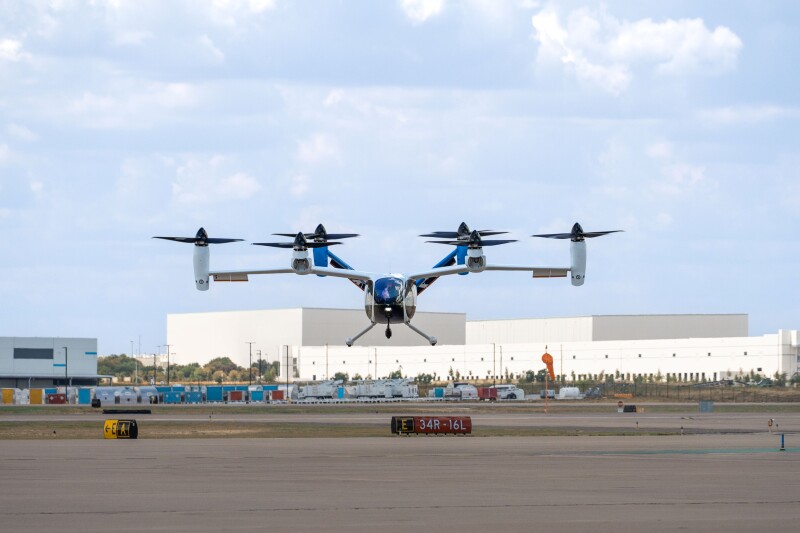
On October 22, 2026, the FAA published Draft Advisory Circular 150/5390-4, Vertical Flight Aircraft Infrastructure Design, another important step toward making Advanced Air Mobility (AAM) a commercial reality in the United States.
The document provides proposed guidance for planning, designing, and constructing facilities that will accommodate a new generation of aircraft, including eVTOL vehicles. It addresses everything from touchdown areas and approach surfaces to lighting, rooftop installations, and electric charging infrastructure.
The FAA is helping the industry design the airports of tomorrow, but as I reviewed the announcement and the proposed guidelines, one question kept coming to mind: Who is going to change the batteries?
When a drone lands in small drone operations, we remove the depleted battery, install a charged one, and send the aircraft back into the air. The procedure takes less than a minute and is performed by the pilot or another member of the operating crew.
In this case, though, we are no longer talking about a small drone carrying a camera. We are talking about aircraft carrying four or five paying passengers over densely populated urban areas, powered by high-voltage battery systems that are essential to keeping the aircraft airborne. That changes everything.

The FAA's new guidance addresses the physical infrastructure needed to accommodate vertical-flight aircraft, including electrical charging systems. Its predecessor, Engineering Brief 105A, also recognized battery swapping as a possible strategy for supporting electric aircraft operations.
Recognizing that batteries might be exchanged is not the same as determining who may perform the exchange, what qualifications they must possess, and what procedures must be followed before the aircraft returns to service.
To understand why this matters, we need to examine something that is not principally a vertiport design question at all: aircraft certification.
A Battery Is Not Always Just a Battery
Under 14 CFR Part 43, the FAA establishes the requirements for aircraft regular and preventive maintenance, including who may perform the work and who may approve an aircraft for return to service.
Interestingly, Appendix A to Part 43 explicitly includes replacing and servicing batteries among the tasks classified as preventive maintenance, provided the work does not involve complex assembly operations. At first glance, that might appear to settle the issue, but it does not.
The battery installed in a conventional aircraft to start an engine or supply electrical power is not necessarily comparable to the propulsion battery of a passenger eVTOL.
An eVTOL battery system may incorporate high-voltage connections, thermal management, sophisticated electronics, cooling systems, and software that continuously monitors the condition of individual cells. It is not simply an accessory. It is part of the system that keeps the aircraft airborne. That's where certification becomes critical.
The FAA has established a type-certification pathway for powered-lift aircraft, including those being developed by companies such as Joby Aviation and Archer Aviation. But the precise maintenance procedures for each aircraft will depend on its approved design, instructions for continued airworthiness, and applicable operating requirements.
Suppose an eVTOL is certified with a propulsion battery that requires removal and replacement under conventional aircraft maintenance procedures. Depending on the approved maintenance arrangements, the exchange could involve appropriately certificated or supervised maintenance personnel, documentation, inspections, and authorization to return the aircraft to service. Now consider a different possibility.
What if the aircraft manufacturer designs its propulsion batteries as modular, rapidly exchangeable units and obtains FAA approval for procedures that permit suitably trained ground personnel to accomplish the exchange within an authorized maintenance framework?
But an important distinction remains: Certifying a battery as modular would not automatically authorize an uncertificated technician to replace it. The FAA would also have to accept or approve the relevant maintenance procedures and personnel arrangements under the applicable regulations. The financial difference between those two operating models could be enormous.
Part 65 governs the certification of aviation mechanics and repairmen. Part 145 governs certificated repair stations. Part 43 establishes much of the underlying maintenance framework, including when individuals other than certificated mechanics may perform certain work.
Therefore, the question is not simply whether every vertiport must employ a Part 65 mechanic with an average salary of $80,000 a year. It is whether the approved aircraft design and maintenance framework will allow routine propulsion-battery exchanges to be accomplished safely, quickly, and economically.

Traceability is another issue. Propulsion batteries may have individual serial numbers, operating-hour or cycle limitations, maintenance histories, and software records. Depending on the aircraft's approved maintenance program, exchanging one battery for another could require specific records identifying the installed components and documenting the work performed.
Those requirements are perfectly understandable in an industry where safety is paramount. But they have economic consequences for the business model. And those consequences become especially significant when we move from a single aircraft to a network of vertiports operating throughout a metropolitan area.
The Hidden Cost of a Five-Minute Turnaround
One of AAM's main promises is that electric aircraft will provide efficient transportation between urban centers, airports, and surrounding communities. For that business model to work, aircraft utilization will be critical.
An aircraft sitting on the ground generates no revenue. Every additional minute between flights affects scheduling, fleet requirements, and ultimately the cost of carrying a passenger. Battery swapping is therefore an attractive possibility. Instead of waiting for an aircraft to recharge, the operator could install a fully charged battery and return the aircraft to service. It sounds simple, but imagine a network of twenty vertiports serving a major metropolitan area.
If battery exchanges require certificated maintenance personnel, specialized equipment, inspections, and individual maintenance records, the economics of operating that network could look very different from the projections based on a rapid, automated turnaround.
Would every vertiport need its own maintenance personnel? Could a qualified technician service several aircraft? Would operators need additional maintenance facilities, battery storage areas, specialized tools, or inspection procedures?
Now imagine FAA-approved aircraft design and maintenance arrangements that allow a trained ground crew to exchange modular batteries using a standardized procedure, without requiring a certificated mechanic to personally perform every exchange.
The potential difference in staffing costs, turnaround time, and aircraft utilization could be substantial.
That is why I believe certification and maintenance authorization may become as important to AAM economics as the batteries themselves or the design of the building.
To be fair, Draft Advisory Circular 150/5390-4 is an infrastructure design document, not an aircraft maintenance regulation. It would be unreasonable to expect the FAA's airport engineering division to resolve every question involving aircraft certification and maintenance personnel.
But that separation of responsibilities does not eliminate the practical problem. Eventually, the different parts of the regulatory framework must meet on the vertiport ramp.
A developer planning a vertiport needs to know more than the landing area dimensions and the capacity of the electrical supply. The developer also needs to understand what facilities and personnel will be required to prepare an aircraft for its next flight.
And those decisions cannot be made intelligently without knowing how the aircraft will be maintained.
There is also an interesting historical parallel. When conventional commercial aviation expanded, airports evolved into complex operating environments with specialized ground crews, maintenance personnel, fueling systems, and supporting infrastructure. The aircraft may have been the technological breakthrough, but the system that kept those aircraft flying became an industry of its own.
Advanced Air Mobility could follow a similar path.
The FAA deserves credit for advancing the infrastructure guidance needed to support this emerging industry. The October 22 publication is an important step, and the agency is seeking industry feedback before finalizing the standards.
But as manufacturers pursue aircraft certification and developers plan vertiport networks, the relationship between aircraft design, maintenance authorization, and infrastructure economics deserves considerably more attention.
The FAA has already established a pathway for certifying powered-lift aircraft. What remains particularly important for rapid battery-swapping concepts is how each aircraft's maintenance requirements will translate into everyday ground operations.
And perhaps the most consequential question in the FAA's latest vertiport initiative is not how much electricity the facility will need or how quickly a battery can be changed, but who will be authorized to change that battery, under what conditions, and at what cost.
Ultimately, with every new regulation or set of guidelines, the industry keeps moving forward, one small step at a time, and that gives me hope for the future.












Comments