
When smartphones first appeared, they were clever but limited devices. You could make calls, send texts, and browse a stripped‑down version of the internet. Few people looked at the original iPhone and imagined Uber, Instagram, mobile banking, or a global gig economy. The transformation only began when the App Store arrived and turned the phone into a platform. Suddenly, software could reach every corner of daily life. The device didn’t change, but the ecosystem around it did.
In a recent conversation with Andre Stein, board director and president, Americas of Speedbird Aero, he said that “drones will be the apps of the physical world,” and I jumped when I heard such a complex forecast expressed in such simple terms. This short sentence captures the moment with unusual clarity. It suggests that drones are not simply aircraft or gadgets, but programmable agents that will automate physical tasks the way apps automated digital ones. The future is difficult to picture because the enabling conditions are not yet in place, but the trajectory is unmistakable.
The analogy works because drones share the same foundational characteristics that made smartphones transformative. They are general‑purpose machines capable of sensing, moving, and acting in the world. They are programmable, meaning their behavior can be shaped by software rather than hardware redesign. Essentially, they are ‘computers that happen to fly,' a sentence that I attribute to Erik Mintz. They are extendable, allowing third parties to build new capabilities on top of a common platform. And they are on a path toward ubiquity, shrinking in cost and complexity as autonomy improves.
What they lack is the equivalent of the App Store moment, the regulatory, technological, and societal unlock that allows them to scale safely and predictably. Until that moment arrives, drones remain stuck in their 2013 phase: impressive hardware constrained by rules, risk, and limited imagination.
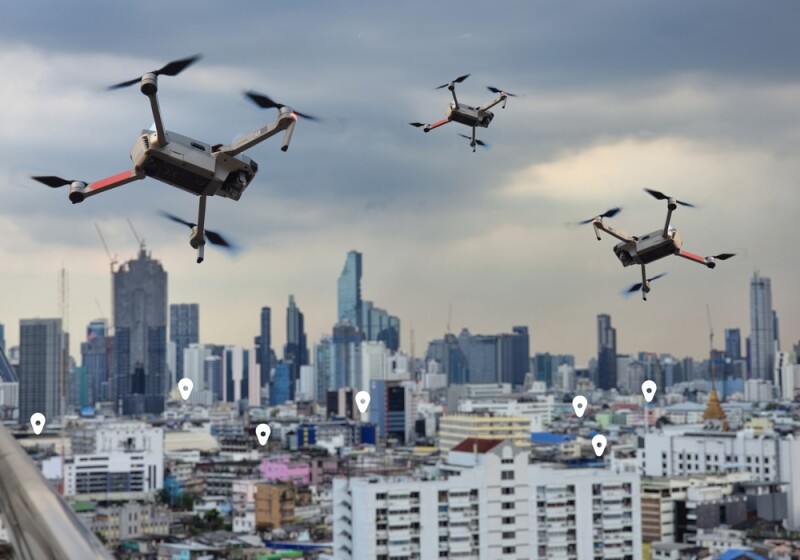
To understand what comes next, it helps to think of drones not as flying vehicles but as software-defined workers. Apps automate digital tasks like messaging, navigation, payments, and photography. Drones will automate physical tasks like inspecting, delivering, measuring, monitoring, repairing, and responding. Each of these becomes a module, a skill, a behavior, the physical-world equivalent of an app. A drone can be loaded with a roof‑inspection ‘app’ in the morning, a crop‑scanning ‘app’ in the afternoon, and a search‑and‑rescue ‘app’ at night. The hardware stays the same; the capability changes with software. This is the moment when drones stop being aircraft and become aerial infrastructure.
The challenge is that today, we can only see the first layer of use cases. Imagine people involved in traditional aviation in 1915; how could they imagine FedExor UPS? Delivery, inspection, mapping, and emergency response are the obvious applications, just as email and web browsing were the obvious early smartphone functions. The more transformative applications, the ones that reshape industries and behaviors, will emerge only when drones become cheap, autonomous, and allowed to operate beyond visual line of sight (BVLOS).
In other words, when the regulatory bottleneck finally opens. Before the App Store, nobody predicted ride‑sharing because the enabling conditions didn’t exist. GPS navigation software was sluggish and clumsy, mobile data was slow, payments weren’t integrated, and there was no distribution channel for third‑party software. Today, drones face a similar set of constraints. Airspace integration is incomplete, detect‑and‑avoid (DAA) is not standardized, public acceptance is fragile, and the regulatory framework is still built around the idea that every drone is a small aircraft rather than a node in a distributed network. Once these constraints fall, imagination will expand.
One of the most compelling futures is the rise of physical APIs (Application Programming Interface). Just as apps call digital APIs to retrieve data, future software will call drones to perform physical actions. A construction manager might ask a system to ‘send a drone to verify whether the site is clear.’ A farmer might request a moisture scan of a specific field. An insurance platform might dispatch a drone to document roof damage minutes after a storm. These are not flights; they are function calls. The drone becomes a physical endpoint in a larger digital workflow. This is the moment drones become invisible infrastructure, woven into the background of daily operations.
Another future lies in hyper‑local logistics. The public tends to imagine drones delivering e‑commerce packages, but the real revolution is the movement of small objects within campuses, hospitals, factories, and neighborhoods. Lab samples moving between buildings, tools shuttling across a construction site, medications traveling inside retirement communities, or documents moving between municipal offices. These are the micro‑flows that keep cities functioning, and drones can automate them with extraordinary efficiency. It is not glamorous, but it is transformative.
A third frontier is the emergence of autonomous micro‑services. Instead of owning a drone, a homeowner or business might subscribe to a service: weekly roof inspections, daily crop‑health scans, hourly air‑quality monitoring, or continuous wildlife detection around a property. The drone becomes a service provider, not a device. This mirrors the shift from owning software to subscribing to cloud‑based applications. The value is not in the hardware, but in the continuous, automated function it performs.
Swarm intelligence adds another layer of possibility. A single drone can inspect a roof; a swarm of fifty can map a wildfire in real time. A hundred can replant a hillside after a burn. A thousand can scan a coastline after a hurricane. Ten thousand can monitor a city’s air quality block by block. Swarms behave like cloud computing in the physical world, massively parallel, distributed, and resilient. This is the kind of capability that is difficult to imagine today because it requires a level of autonomy and coordination that regulations do not yet permit. But the underlying technology is advancing quickly, and once the policy environment catches up, swarms will become a normal part of environmental management, disaster response, and infrastructure monitoring.
Perhaps the most human‑centered transformation is the extension of our senses. Smartphones extended our memory, communication, and navigation. Drones will extend our vision, reach, and presence. A homeowner might ask a drone to check the roof in real time. A utility worker might inspect the underside of a bridge without climbing. These are simple examples, but they illustrate a deeper shift: drones become remote eyes and hands, giving people safe access to places they cannot easily reach.
The final stage of this evolution is invisibility. The smartphone became world‑changing when it became boring, when it blended into daily life as a natural extension of human capability. Drones will follow the same path. They will shrink, quiet down, integrate seamlessly and automatically into the sky, and become predictable. They will be regulated like elevators or traffic lights. They will fade into the background, and what people will notice are the services they provide, not the machines themselves.
The idea that “drones will be the apps of the physical world” is not only a powerful metaphor but our roadmap. It suggests that the true impact of drones will not come from the aircraft but from the ecosystem that forms around them. We are still waiting for the ‘App Store’ moment, the regulatory unlock that allows drones to scale safely and meaningfully. When that moment arrives, drones will stop being flying robots and start being the physical infrastructure of a more automated world. And just like the smartphone, the most transformative applications will be the ones we cannot yet imagine.






Comments