


Today’s aerial surveying landscape can be a challenge to navigate, regardless of your experience level. New regulations dictate how far you can fly, the push to integrate AI into your workflows is prominent and keeping up to date with new technologies while remaining compliant can feel like a daunting task.
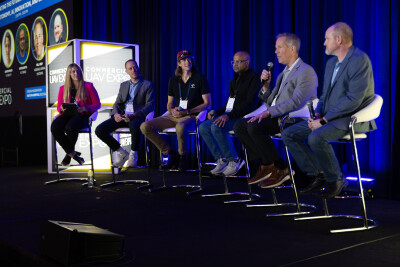
In Commercial UAV New’s recent webinar, Navigating the Future of Drone Surveying: Tech Stack, AI, and Regulatory Changes, panelists broke down the nuances of surveying today and provided expert advice on how to set your team up for success before introducing new technologies into your day-to-day operations. This webinar included insights from Rob Knochenhauer, director of regulatory affairs at Censys Technologies and Edwin Sanchez, CEO of VOTIX and was moderated by Erin Sewall, content specialist at CUAV News.
Data- First Workflows
An overall theme of “have your house in order” before integrating AI tools to automate your workflows kept coming up in the conversation. The panelist could not stress strongly enough the value of prioritizing the quality and self-sufficiency a workflow should have before anything else gets added into it. They noted how important it is to prioritize end-to-end data workflow design. Automated uploads, image quality checks, processing triggers, and structured storage must be running smoothly before layering in AI so models operate on clean, timely data and deliver reliable insights.
“Many of the AI technologies you see out there will rely strongly on the data that you have and how structured that data is, and how the workflow manages that data from one point to the other point to the other,” Said Sanchez.
“If that’s not working, you will end up paying a lot of money in AI tech that won't work no matter what, or that will produce inaccurate results for you.”
Layer Your Tech Stack
On the topic of adopting new technologies, the conversation moved into a discussion around how to build the right tech stack that will serve your projects well over time. In order to do this, panelists suggested taking a layered approach to build something that is resilient and evolvable. The three key layers include data acquisition, data processing and management, and operational intelligence.
“First, you should focus on understanding your workflow in the data acquisition part. What are the drones, the sensors, and what are the workflows to repeat the data capture? Based on that, then you can define what the specific needs are for that workflow at that layer level,” said Sanchez.
The second layer should focus on defining the needs of data processing and management.
“I look at how I need to store, retrieve, and distribute data? How do I organize it or eventually safeguard it? Answering these questions that will bring me into a specific set of needs that can help me pick the right technology for that,” said Sanchez.
The last layer of your tech stack should help you make decisions based on the processed data and give your clear insights from that data.
“Asking yourself ‘How do I run AI analysis on top of that?’ or, or ‘How do I present information in a way that can help decision makers make better decisions in the process?’ will help define what technology is worth it,” explained Sanchez.
These three key considerations serve as a toolkit to turn to when deciding on what individual technologies will work best in tandem, for your team and for the longevity of the project.
Scaling to BLVOS Operations
Flying beyond visual line of sight is a great way to gather incredible amounts of survey data, but it is easier said than done. Beyond getting the appropriate waivers, there are many safety concerns to consider before scaling your project up to this point.
Panelists reiterated how important it is to start with clear operational rationale and a robust safety case that explicitly addresses air and ground risk before you take off. This includes aircraft reliability, operational history, and proper exemptions.
As Knochenhauer explained, the first step is a thorough risk identification process: "You need to go through the exercise of identifying what all the risks are in the areas that you want to fly beyond visual line of sight."
On the air risk side, that means understanding what other aircraft may be operating in the vicinity and ensuring your flight plan is fundamentally safe to those aircraft. Ground risk requires an equally careful look at the terrain and population below. For most surveying or linear infrastructure operations, flights tend to pass over unpopulated areas, but one challenge that comes up regularly is the need to cross public roads.
“Operators must ask themselves how they are satisfying the added risk of exposure of the potential of your drone crashing onto a roadway and causing an additional hazard," explained Knochenhauer.
Open Compliance Strategy
Technology compliance is on the top of everyone’s minds lately. The panelists offered straight-forward and candid advice on how to choose the right compliant technology that can serve your team for years to come. Regulatory and supply-chain shifts, from the FCC covered list and NDAA requirements to the forthcoming Part 108 rules, are pushing the industry toward system-level reliability and open, integration-friendly solutions.
When choosing new technology, using a variety of brands will help prevent your workflow from hitting roadblocks in the future.
"Stay away from those technologies that are single branded in the fullest stack because that's going to lock you in and you will end up missing the opportunities of bringing new tech into your workflow," said Sanchez.
On that note, Sanchez emphasized the need for technology to be flexible and capable of integrating with other systems.
"Even small format drones or different drones that are specific for certain workflows will have to be open to integration with different platforms for them to remain relevant in the market," he explained.
The same open-system thinking applies to the waiver process.
Knochenhauer highlighted a practical resource many operators overlook, the FAA's Waiver Safety Explanation Guidelines. "If you type those four words you'll find it pretty quickly," he noted, explaining that the document contains the exact questions an FAA evaluator will be looking for in an application. He advised putting those questions in the application verbatim, and answering them in plain, direct language.
One of the most common and costly mistakes is assuming the evaluator shares your operational knowledge. He cautioned that even obvious safety measures need to be spelled out explicitly.
"Those common-sense things that seem obvious to you are basically not obvious to the person evaluating your safety case," explained Knochenhauer.
When building your waiver application, err on the side of over-explanation rather than assuming anything goes without saying.
These were only a few pieces of the robust conversation that encompassed this webinar. The entire webinar can be viewed for free by filling out the registration form at the link below.










Comments