
.jpg.medium.800x800.jpg)
One of my goals every year when I attend Commercial UAV Expo is to look for interesting and innovative business models. This year, the event did not disappoint on that front, with many new ideas and excitement around the imminent release of Parts 108 and 146, making it difficult to discern which business models deserved a dedicated chronicle.
The industry has shown it's ripe for more applications, and this use-case growth will inevitably translate into demand for services and the need to add drones to existing workflows. One way companies will meet this requirement is to buy drones and begin the slow process of becoming an aviation entity. Another alternative is to seek service providers, but the challenge will be figuring out where to find them.
One solution might be to launch a drone-as-a-service marketplace similar to, but far more complex than, Uber and Lyft. With today’s technological environment and an increasingly mature FAA regulatory environment, UAS can function as reliable, scalable service providers. In this regulatory environment, a marketplace for drone services is a practical inevitability.
We had the opportunity to interview Alexandra López, CEO of Drone People, who explained the genesis of her company and the challenges of launching such a service as we wait for formal regulation.
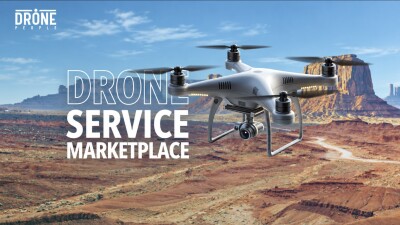
“Drone People was created to solve a persistent problem in the commercial drone industry: Organizations need specialized aerial services, but finding and evaluating the right provider is still highly fragmented,” López said. “A client may have to search online, contact operators individually, compare proposals in different formats, and independently determine whether each provider meets the requirements of the mission."
"We are bringing that process into a trusted marketplace. Drone People allows organizations to access qualified providers for services such as inspections, mapping, construction documentation, data collection, and media production. Our broader objective is to develop a trusted interoperability layer that connects participants in the low-altitude economy and makes commercial drone operations safer, more transparent, and easier to scale.”
Academic and industry literature has been quietly building toward this moment. Although no single paper describes a fully mature “Uber for drones,” several bodies of research converge on the same foundational concept: drones operating as service units within a coordinated digital marketplace. The most explicit treatment of this idea appears in studies of Drone‑as‑a‑Service (DaaS), a term used to describe drones not as owned assets, but as on‑demand providers dispatched through a platform.
An IEEE survey on DaaS outlines how drones can be dynamically allocated for inspection, monitoring, delivery, and emergency response. The authors emphasize that drones' true value emerges when a centralized system orchestrates them by managing scheduling, compliance, and mission optimization. This is the same logic that underpins ride‑sharing platforms, where the platform, not the vehicle, creates the value by coordinating supply and demand.
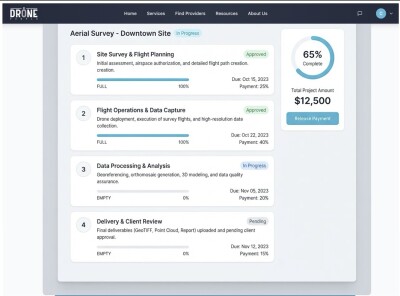
“Drone People supports the complete service process, from mission planning and provider qualification through delivery and payment. AI assistants help clients translate their projects into technically structured requests that providers can evaluate more easily. AI also helps providers prepare budgets faster while keeping final scope and pricing decisions in their hands,” López said.
"The platform validates pilot licenses, aircraft registrations, and Remote ID information against FAA databases. Each validation generates a Digital Trust Credential based on W3C Verifiable Credentials technology, with cryptographic proof compatible with Ed25519, Bitstring Status List, and ISO/IEC 18013-5. This gives clients secure, tamper-evident proof that essential requirements have been checked. Our goal is for this framework to become an industry validation standard and a trusted interoperability layer for the low-altitude economy.”
But how do you price the service so all parties win? A Springer study on cooperative UAV service strategies examines how multiple drone suppliers interact with a central coordinating platform. The research explores pricing models, service allocation algorithms, and cooperative strategies that increase operator profitability while improving service reliability for customers. The dynamics described in the study mirror the mechanics of existing gig‑economy platforms: independent providers join a marketplace, the platform manages dispatch and customer interaction, and the system optimizes for efficiency and utilization.
The authors conclude that UAV suppliers benefit significantly from platform participation because it reduces idle time, increases mission density, and lowers customer acquisition costs. In other words, drones become more economically viable when aggregated through a marketplace rather than operating as isolated service providers.
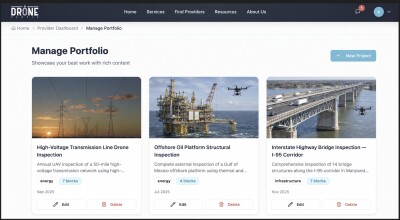
“Drone People is a two-sided marketplace built to create value for both service seekers and service providers. For clients, transparency means access to multiple qualified providers, comparable proposals, and direct communication instead of relying on a single referral or an opaque procurement process. For providers, the marketplace creates access to relevant commercial opportunities while allowing them to compete on their qualifications, experience, proposed methodology, timing, and price,” López said.
“Our revenue model combines subscriptions with a low commission charged only on completed and approved projects. The Free plan has no monthly cost and carries a five percent commission. Providers can reduce that rate by selecting the $50-per-month plan, with a two percent commission, or the $100-per-month plan, with a 0.5 percent commission. This gives each service provider the flexibility to choose the model that best matches its project volume and growth stage. We also offer an Enterprise plan for providers seeking a more proactive growth partnership, including a full-time sales team dedicated to generating business opportunities. This structure aligns our success with the provider’s success while supporting transparency, trust, and secure project execution.”
The Drone People thesis is that business models ranging from subscription services to pay‑as‑you‑go platforms are all feasible, but the most scalable model is a multi‑provider marketplace. Drones have long return‑on‑investment cycles when operated independently, but when aggregated through a platform, the economics shift dramatically. The platform reduces downtime, increases mission frequency, and provides a unified interface for customers who would otherwise struggle to identify qualified operators.
The initial verticals, including infrastructure inspection and event management, are already accustomed to hiring drone operators, and Drone People leadership believes that a marketplace model will be adopted once BVLOS operations become routine.
The missing piece has always been regulatory. Without BVLOS flights, drones cannot operate autonomously, travel meaningful distances, or be dispatched on demand. Parts 108 and 146 resolve this barrier. It creates the conditions for drones to function as reliable service units capable of responding to customer requests across a city or region. Once BVLOS becomes standardized, the marketplace model becomes not only feasible but strategically advantageous. Although the Drone Place marketplace is operating today and helping Part 107 operators and service seekers, the potential for exponential growth is real with Parts 108 and 146.
The implications extend beyond drones. As the FAA continues to develop the regulatory framework for air taxis and other advanced air mobility vehicles, the marketplace concept becomes even more compelling. A unified platform could eventually coordinate both low‑altitude drone operations and higher‑altitude air taxi services, creating a vertically integrated aerial mobility ecosystem. If drones and air taxis share digital infrastructure, traffic management systems, and customer interfaces, a single marketplace could manage both. This would mirror the evolution of ground‑based mobility platforms, which expanded from ride‑sharing to food delivery, freight, and micromobility.
As Parts 108 and 146 approach publication, the industry stands at the threshold of a new era. The regulatory foundation is aligning with the technological capabilities and economic models described in the literature. The marketplace concept in operation today is ready to grow to the next level, and it seems like the natural next step in the evolution of drone services.
The studies on Drone‑as‑a‑Service, platform‑coordinated UAV suppliers, and 5G‑enabled drone ecosystems collectively provide the intellectual scaffolding for a future in which drones are hired, dispatched, and managed through a digital marketplace. The FAA’s regulatory shift will accelerate this transition, enabling drones to operate with the autonomy, reliability, and geographic reach required for marketplace viability.
In the coming years, the drone industry will likely see the emergence of platforms that aggregate operators, standardize services, and give customers seamless access to aerial capabilities. These platforms will not replace traditional operators; they will amplify them. They will not eliminate regulatory complexity; they will manage it, adapting the ride-sharing model to the unique dynamics of aerial robotics. The marketplace era for uncrewed aviation is here to stay and is about to experience exponential growth.









Comments