

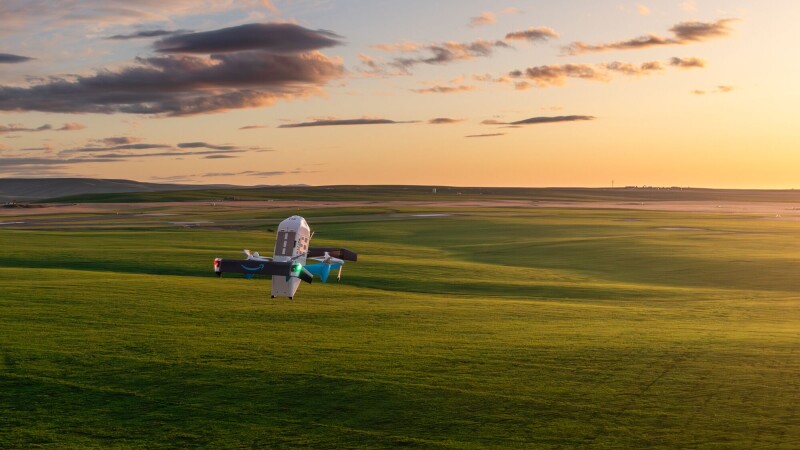
.png.small.400x400.png) The consumer-based drone delivery market is continuing to expand across the United States, with both food and consumer goods deliveries growing rapidly over the last 12 months. On Wednesday, Amazon shared plans to expand its own delivery services significantly before the end of the year. The delivery giant indicated that its Amazon Prime Air service plans to reach nearly 500 cities and towns across the country, a sixfold increase from its current footprint. Amazon indicates that this expansion will potentially bring its services to tens of millions of people across these communities.
The consumer-based drone delivery market is continuing to expand across the United States, with both food and consumer goods deliveries growing rapidly over the last 12 months. On Wednesday, Amazon shared plans to expand its own delivery services significantly before the end of the year. The delivery giant indicated that its Amazon Prime Air service plans to reach nearly 500 cities and towns across the country, a sixfold increase from its current footprint. Amazon indicates that this expansion will potentially bring its services to tens of millions of people across these communities.
Today, Amazon Prime Air’s services are available in Arizona, Florida, Kansas, Louisiana, Michigan, Nebraska, and Texas, with the company indicating it will “soon” be launching in and around Atlanta, Georgia; Cleveland, Ohio; Chicago, Illinois; Boise, Idaho; and Syracuse, New York. The company adds that additional communities will be announced later this year.
Amazon notes that most Prime Air locations offer millions of items, with nearly all items weighing five pounds or less and fitting in a large shoebox eligible for drone delivery. That encompasses over 60 percent of the items customers most frequently purchase from Amazon. Deliveries are typically received around 60 minutes after purchase, with some arriving as quickly as 30 minutes.
“Customers already turn to Amazon for fast Same- and Next-Day Delivery, and Prime Air provides them an even speedier option when they need it, with deliveries in as fast as 30 minutes,” said David Carbon, vice president of Amazon Prime Air, in a statement. “We've already delivered hundreds of thousands of packages to customers by drone this year, and by the end of 2026 we plan to reach customers in nearly 500 cities and towns.”
In its announcement of the plans, Amazon calls out a few critical components of its operations for a general public that is largely unfamiliar with the commercial UAS sector, directly responding to many of the most common criticisms that come from the public when new consumer-facing UAS products enter a market.
On the topic of safety, for example, Amazon points to its Part 135 certification from the FAA, noting that it is the highest level of FAA oversight for its type of operations and the same framework used for commercial air carriers. The company also calls out its in-house detect-and-avoid system, which it calls “industry-leading” and compares to a trained pilot who scans surrounding airspace to make real-time flight decisions.
Potential concerns around privacy and noise levels are addressed as well. On the former, Amazon makes clear that its onboard camera and sensors are only used for navigation, obstacle detection, and safe delivery, and that there is no tracking or recording of movement, nor are live feeds monitored by any people. With noise also being a common concern around these operations, Amazon says that the sound level from the drones at drop-off is below that of an idling delivery truck parked at the curb, and that at altitude it’s comparable to a window fan on low and not typically heard indoors.
As drone-based delivery for all purposes – be it for regular consumer purchases like Amazon provides, or food deliveries, or medical deliveries – continues to expand, the points addressed here by Amazon can’t be ignored by the major players. Every public meeting about bringing these deliveries to a local community will include questions about at least one of these topics, and probably all of them. Of course, a press release is only part of the trust-building process, with the rest having to come from real-world experiences in the field.









Comments