The information you submit will be stored and used to communicate with you about your interest in Commercial UAV News. To understand more about how we use and store information, please refer to our privacy policy.
Sponsored by Apellix, with product specifications obtained directly from the manufacturers and regulatory information cited from the FAA and OSHA.
Quick answer: Manufacturers of purpose-built cleaning drones argue that dedicated systems are more suitable for commercial exterior cleaning than retrofit inspection drones because they are engineered for continuous spraying, chemical exposure, higher operating pressures, and (sometimes) redundant motors. The three primary U.S. manufacturers of dedicated cleaning drones are Apellix (Jacksonville, FL), Lucid Bots (Charlotte, NC), and Aquiline Drones (Hartford, CT). A complete drone cleaning startup package costs $75,000–$105,000, and operators at the top of the market report earning $2,500 per hour. Apellix's Power Wash Drone is the most widely deployed commercial cleaning drone worldwide, with active operators in 21 countries across 5 continents.
Regulatory weight limit: 55 lbs (25 kg) total system weight under FAA rules
Cited working heights: up to 195 ft (Apellix) and 150 ft (Lucid Bots)
Flight time: 15 – 25 minutes typical per battery set; up to 32 minutes (Apellix B2)
Required license: FAA Part 107 remote pilot certificate
Hull insurance: 8 – 12% of drone value per year; $1M liability coverage: $500 – $1,200/year
Why Drone Cleaning is Growing
Over the years, verticals like inspection, photography, and surveying, among others, have seen a rapid increase in drone adoption. While these are great career avenues, they have largely been absorbed by in-house teams, leaving fewer opportunities for independent contractors. Yet there is one task in life that is ever-present, which drones can make significantly easier: cleaning.
Traditional methods used to clean buildings and other tall infrastructure require lots of expensive scaffolding or harness rigging, and a person being put in harm’s way to climb the structure and complete the work. Drones present the opportunity to cut the costs of expensive lift methods while reducing risk on the job site. For example, in 2024, 37% of construction fatalities in the US were due to fatal falls according to BLS data cited by OSHA (389 fatal falls out of 1,034 construction fatalities). Cleaning drones eliminate fall risk entirely because the operator never leaves the ground.
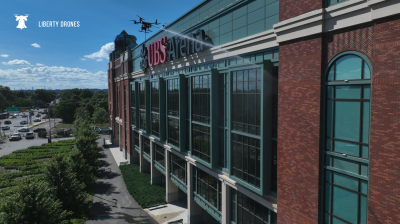
Demand is now shifting from "willing to try drones" to "requesting drones by name." When the Blue Cross Blue Shield building in Jacksonville, Florida went out to bid for exterior cleaning, the bid specifically requested drone cleaning. AirX, an operator flying an Apellix cleaning drone, won the contract over the building's incumbent window washing company.
What is a Cleaning Drone?
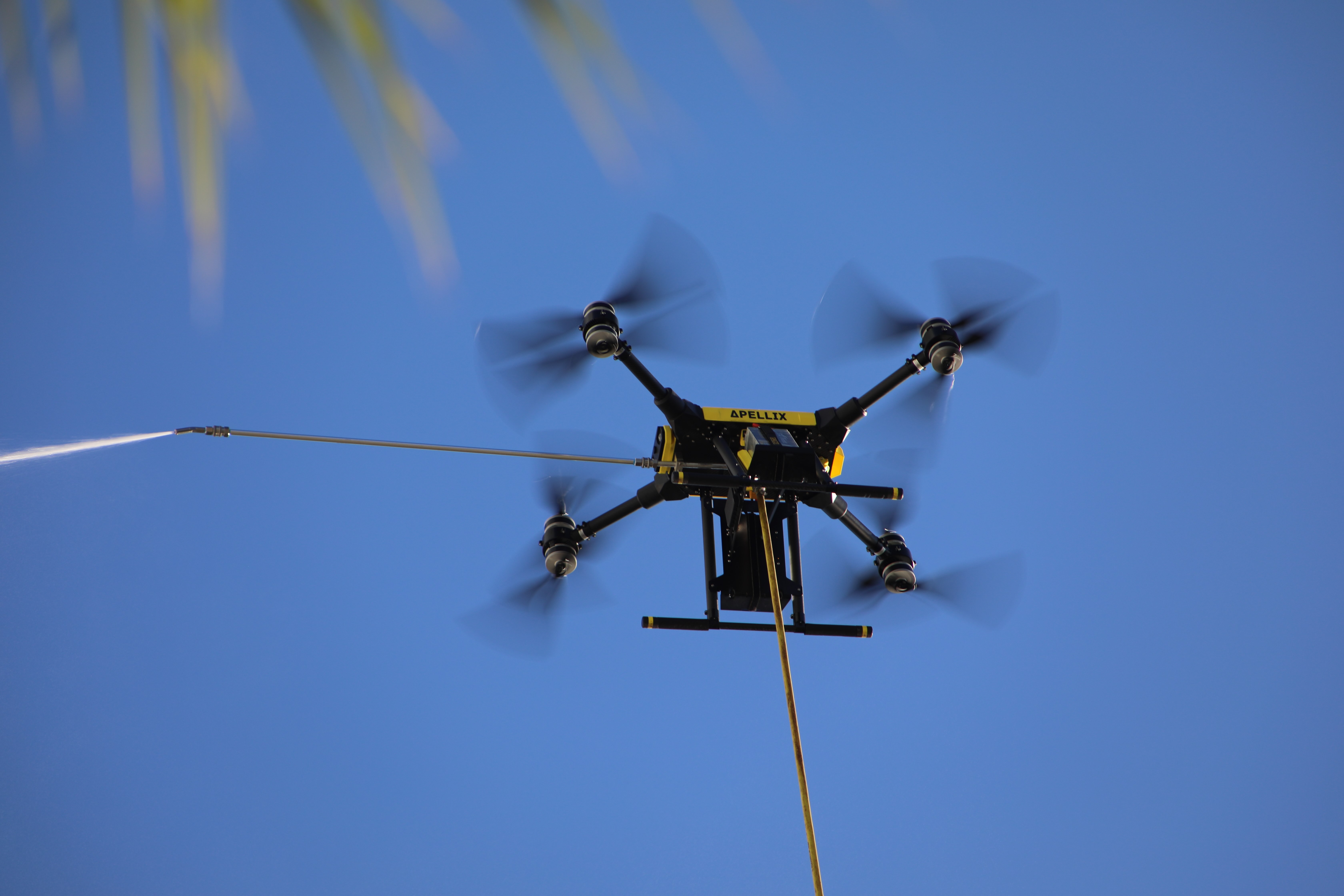
A cleaning drone is an unmanned aircraft purpose-built to spray water and cleaning solution onto exterior surfaces (building facades, windows, roofs, tanks, and towers) while tethered by hose to ground-based pumping equipment.
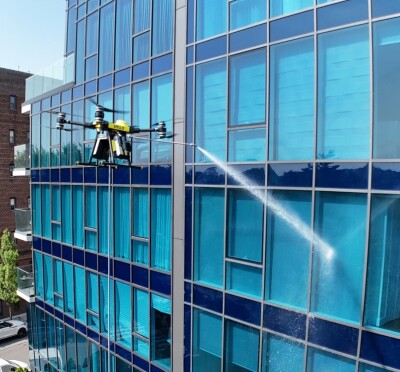
Apellix drone washing windows
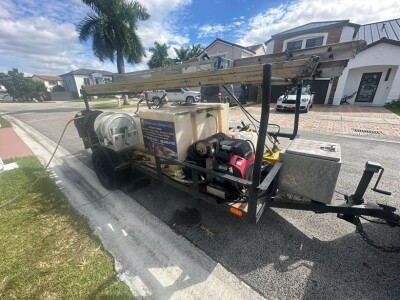
The drone carries the nozzle and hose aloft; the water, chemicals, and pressure all come from the ground.
This architecture keeps the aircraft light, allows continuous spraying without landing to refill, and makes battery life (not water capacity) the operational limit.
Advantages of cleaning drones:
No scaffolding or boom lift rental – access costs eliminated entirely
Access to complex geometry -- steeples, curved buildings, buildings next to retention ponds or rivers
Lower insurance costs than rope-access or lift-based crews
Limitations of cleaning drones:
Wind sensitivity limits flyable days
FAA regulations (Part 107 certification, NDAA-compliance required for some jobs)
Operator training is required
What is Soft Washing?
Soft washing is low-pressure exterior cleaning (typically under 600 PSI) that relies on cleaning with surfactants rather than pressure to remove organic growth like algae, mold, and mildew. It is the standard method for painted surfaces, roofs, stucco, and windows, and it is the most common drone cleaning application. Any chemical that you are currently soft washing with, like Dawn Dish Soap or CitraShield, can be sprayed through a purpose-built cleaning drone. Watch a drone soft wash a historic church in Australia.
What is Pressure Washing?
Pressure washing uses high-pressure water (1,500 – 4,000 PSI) to remove dirt. Purpose-built cleaning drones can handle high-PSI work that retrofitted inspection drones struggle with, which is one of the clearest dividing lines between the two categories.
What Makes a Cleaning Drone Reliable?
The top consideration for a cleaning drone is reliability.
Buy purpose-built, not retrofit. A DJI inspection drone with a bolt-on water kit is cheaper up front, but it is not designed for continuous spraying, chemical overspray, or high PSI, and it will not hold up under daily commercial cleaning use.
Look for motor redundancy. Apellix drones carry an extra motor on each arm, so if one motor fails mid-flight, the aircraft completes the job safely instead of falling out of the sky. Hardware redundancy is the difference between an inconvenience and a lost aircraft.
Other reliability markers to compare:
Long flight time per battery set
Window cleaning capability without additional add-on purchases
Autonomy or waypoint flight planning
Maximum working height
Manufacturer track record: of the first ten drones Apellix sold (starting in 2023), nine remain in heavy active use in the United States.
Cleaning Drone Comparison Chart (July 2026)
Lucid Bots
Apellix B2 / Blue
DJI Matrice 300 RTK
Aquiline AD Endure
KTV Working Drones
Origin
U.S.
U.S.
China — no longer available for new purchase in the U.S.
U.S.
Norway — no longer available for new purchase in the U.S.
Price
Base Price: $75,000 for “full package”, which includes drone + accessories
Option to rentfor$106,200over3 years
B2: $47,000 Blue: $60,000
Priceincudesdrone + accessories
$8,000 - $10,000 + additional spray equipmentand parts to create your own spray cleaning drone
Not published
Available as franchise package
NDAA compliant
NDAA compliant model available.
If usingSIYIcontroller, it is not NDAA compliant.
Yes — has NDAA compliant model
No– built in China
Yes
No — built on Chinese-made DJI airframes
Maxheight
150 ft
195 ft
Depends on spray system installation
Not Published
Similar toDJI base
Weight
37.2lbswith batteries
B2: 31.5lbswith batteries
13.9lbswith batteries + added sprayer weight
24.2 lbs without battery - weight with battery not published
The chart above highlights the cleaning drones on the market now, and what capabilities and additional services they include. Of the purpose-built options, Apellix, Lucid Bots, and Aquiline are US-manufactured; Apellix, Aquiline, and KTV include window cleaning without purchasing extra add-ons, DJI, KTV, and Apellix offer some sort of autonomy or waypoint flight planning; Apellix and Aquiline offer remote training.
Source for chart: Manufacturer specifications were collected during June – July 2026 from publicly available documentation and verified where possible through demonstrations, interviews, published videos, and customer case studies. Specifications may change over time.
What Exterior Cleaning Drones Can Actually Do
Cleaning drones handle anything previously done with a ladder, lift, or scaffold:
Emerging uses — breaking ice dams off roofs with hot water in northern climates, washing garbage trucks and fleet vehicles, and CBRN decontamination for military applications
To see the direction the technology is headed, watch “Apellix Intelligence (AI) LIVE Launch | Autonomous Cleaning is Here”- the autonomy system developed in collaboration with the U.S. Army, now brought to commercial drones. It's a useful watch if you want to understand where the autonomous drone cleaning technology is heading and how much of the flying the software can handle. Apellix Operator Softwashing Church With Drone! is the practical counterpoint: an operator soft washing a church, exactly the kind of tall, awkward, detail-heavy structure, steeples, ledges, tight angles, that traditional rigging struggles with. It's a good look at stability and precision that separates a purpose-built cleaning drone from a modified inspection unit.
There are even a few emerging use cases such as breaking ice dams off roofs with hot water, cleaning vehicles like garbage trucks, and even CBRN decontamination for military use.
FAQ
What does it cost to get started in drone cleaning?
Entry into exterior drone cleaning is often described as “business in a box." A complete starting setup runs $75,000 – $105,000: $47,000 – $75,000 for the drone/accessories and roughly $30,000 for window-capable ground equipment.
Lucid Bots offers the drone and accessories for $75,000, with the option to rent the drone for $2,950 per month, totaling to $106,200 over 3 years. Apellix offers the drone and accessories for $47,000 or ($60,000 for the NDAA-compliant version). Drone-ready ground equipment that can clean windows ranges around $30,000.
How fast can a drone cleaning operator expect a return on investment?
Apellix and Lucid Bots each cite customer case studies reporting revenue rates approaching $2,500 per operating hour on certain commercial projects. Actual profitability varies substantially based on utilization, market, labor costs, and contract pricing. At that pace, the payback period on the drone can be as short as three to six months, but real-world results vary widely with location, contracts, and how aggressively the business is run.
Could a drone cleaning business make a million a year?
Yes. At Apellix’ headquarters in Jacksonville, Florida, the Company has a “Wall of Millionaires”, which features Apellix operators that have bought 1 cleaning drone and brought in over $1 million in annual revenue, from the United States to Australia.
What kind of maintenance do cleaning drones need?
Plan on an annual factory inspection with the manufacturer. Day-to-day care is mostly about safe handling: getting it in and out of its case without chipping propellers. If chemicals do contact the drone, neutralizing agents can be run through the motor area. Also check on the drone’s country of origin to see if the company does maintenance outside of that country and what kind of global footprint they have. As a durability marker, nine of the first ten drones Apellix ever sold (starting in 2023) remain in heavy active use.
What training is required to operate a cleaning drone?
Like any commercial drone pilot, operators need an FAA Part 107 remote pilot certificate, which manufacturers like Aquiline and Apellix can help coordinate.
Beyond government licensing, check what drone-specific training you receive. Lucid Bots provides hands-on training for 3 people at their North Carolina headquarters for $2,500. Aquiline offers hands-on training for 2 people for free at their Connecticut headquarters. Apellix offers hands-on training for an unlimited number of people at their Florida headquarters for free. Both Apellix and Aquiline also offer remote training, while Lucid Bots does not offer remote training at this time.
What kind of support should a buyer expect?
High-quality customer service will be a driving factor in your business’s success. If you run into an issue with your drone, being able to get on the phone with a live person to help troubleshoot or have them come to you will make all the difference in your experience and how smoothly your business runs. Questions worth asking include, can technicians travel to you for repairs? Is phone support available?
How much does drone cleaning insurance cost?
Hull insurance protects the drone itself against crashes, flyaways, theft, or chemical damage and is priced at 8 – 12% of the drone's value per year. Annual commercial liability insurance is the coverage that protects against third-party injury or property damage claims. Pricing follows coverage limit, not drone value. A $1 million coverage limit is $500 – $1,200 per year and a $2 million coverage limit is $1,200 - $3,500 per year.
How high can a cleaning drone reach?
Height is governed on weight. There is a 55lb/25kg regulatory limit for how much the drone, plus the water, hose and cleaning solution, can weigh. A lighter airframe therefore flies higher before hitting the limit. Apellix cites a working height of 195 feet (the B2 weighs 31.5 lbs with batteries); Lucid Bots cites 150 feet (the Sherpa weighs 37.2 lbs with batteries); the Aquiline AD Endure weighs 40.2 lbs with batteries.
How long can a cleaning drone fly?
Cleaning drones typically fly 15 – 25 minutes per battery, with operators hot-swapping batteries throughout the day to keep jobs moving. The water itself is not carried onboard — it's fed from ground equipment through a hose — so battery life, not water capacity, is the limiting factor. The Apellix B2 flies up to 32 minutes per set of batteries, and operators are given 8 batteries and 2 rapid chargers when they buy an Apellix drone. The Lucid Bots Sherpa can fly up to 19 minutes per set of batteries. According to a spec sheet published by Lucid Bots, a 4-hour job includes 120 minutes of flying and 74 minutes of waiting for 62% total flying in a 4-hour window.
Can cleaning drones handle soft wash chemicals like sodium hypochlorite?
Yes. Purpose-built cleaning drones are designed to spray sodium hypochlorite (SH) solutions, surfactants, and standard exterior cleaning chemicals. The chemistry runs from ground equipment through the hose to the nozzle, so pumps and lines never sit soaked in solution, and components are selected to tolerate chemical exposure — another dividing line versus retrofitted inspection drones. Watch a drone soft wash.
Is drone cleaning cheaper than traditional methods?
For tall or hard-to-access structures, usually yes — often dramatically. Traditional cleaning on a mid-rise or high-rise requires lift rentals, scaffolding, or rope-access rigging that can add thousands to tens of thousands of dollars in access costs before any cleaning begins. A drone crew arrives with everything in a trailer, sets up in under an hour, and eliminates access costs entirely. Operators can quote below scaffolding-based bids while keeping premium hourly rates — and fall risk drops to zero.
What regulations apply to drone cleaning beyond a pilot's license?
Beyond the FAA Part 107 certificate, operators should plan for a few recurring requirements. Drones must be registered with the FAA, and jobs in controlled airspace near airports require LAANC authorization, which is typically granted in near real time through approved apps. Flights over people or moving vehicles have additional restrictions that affect how jobs on busy streets are staged. Some states and municipalities layer on their own rules for commercial drone operations, so checking local ordinances is part of quoting any new market. None of this is a significant barrier — thousands of operators manage it daily — but buyers should favor manufacturers whose training covers the regulatory workflow, not just the flying.
How long does a drone cleaning job take?
A facade that would take a rope-access crew several days can often be soft washed in a single day, because the drone moves across the surface continuously instead of repositioning rigging floor by floor. Setup takes minutes, not the hours or days scaffolding requires. Example: CleanFlight Solutions cleaned the Raymond James Headquarters in 11 hours — a job that had taken 11 days with traditional methods for the previous decade. Read the case study.
The Bottom Line
Choosing the right cleaning drone comes down to the fundamentals this guide walked through: reliability, redundancy, reach, and a manufacturer that stands behind the hardware with real support and training. Get that right, and an exterior cleaning drone stops being an expensive piece of equipment and starts being the core of a business.
If you want to see how that plays out in practice, Apellix's case studies are a good place to start. From the University of Florida campus to operators like Drone Shine and CleanFlight Solutions, they show the range of jobs, and the kind of work independent operators are booking today.
About the sponsor: Apellix designs and manufactures autonomous drones for power washing, spray painting, inspection, and building maintenance. Apellix’ Power Wash Drone is the most widely deployed commercial cleaning drone worldwide, with active operators in 21 countries and 5 continents as of mid-2026. The Company was founded in Jacksonville, Florida in 2014 and is 100% made and manufactured in the USA. Apellix has National Defense Authorization Act (NDAA) compliant options, employs disabled veterans, and is flown by the U.S. Army.
.jpg.small.400x400.jpg)




Comments