

Sponsored by GDU Tech
City drone programs are wide ranging, with a variety of applications necessary across, and within, departments. The same department may need riverbank inspection in the morning, a thermal check at a fire scene in the afternoon, and a loudspeaker-equipped aircraft after dark. GDU designed the S400E, an industrial-grade quadcopter, to cover that range by pairing a foldable airframe with swappable payloads and optional dock-based operation.
The S400E uses a magnesium alloy frame that folds to 347 x 367 x 424 mm with the tripod and propellers attached. It fits in a backpack as well, so one operator can carry it without large transport equipment. The airframe weighs approximately 4 kg, and maximum takeoff weight is 7 kg.
GDU lists a maximum flight time of 49 minutes (hovering in no wind or light wind, battery from 100 to 0 percent), a 3 kg payload capacity, an IP45 rating, resistance to 11.8 m/s wind, and an operating temperature range of -20°C to 55°C. At maximum payload, safe flight speed drops to 15 m/s. The aircraft also carries ADS-B to help avoid civil aircraft in the surrounding airspace.
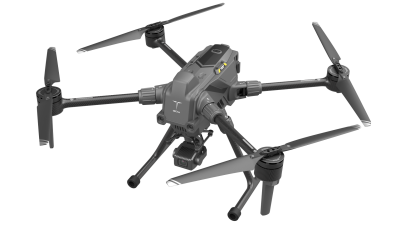
Urban flight puts wires, buildings, and signal interference close together. The S400E combines vision sensors with millimeter-wave radar for obstacle avoidance. According to the spec sheet, forward detection covers 0.7 m to 40 m and reaches large metal objects up to 80 m away. Side detection covers 0.6 m to 30 m, and the upward, downward, and rear sensors cover 0.6 m to 25 m, so the system can detect small obstacles such as high-voltage lines.
For communication, GDU lists a 15 km video transmission range, measured at 200 m altitude without interference. When satellite or data links are disrupted, a visual positioning fusion algorithm and frequency-hopping image transmission support return to home. The optional A4G-400 module adds 4G connectivity and switches to the cellular network when the video signal is blocked or interfered with. Where no network coverage exists, multiple S400E aircraft can form a relay network in one-for-two, two-for-one, or star configurations. This arrangement maintains communication around building obstructions and mountainous terrain.
Payloads and onboard analysis
The S400E carries up to 3 kg, and operators choose the payload for each mission. GDU’s flagship gimbal integrates five modules: a 1/0.98-inch wide-format camera, a 34x continuous optical zoom camera, a 1K-resolution infrared thermal imager, a laser rangefinder, and a near-infrared auxiliary light. GDU lists 10.4T of AI computing performance for the gimbal. The aircraft is also compatible with tri-sensor and quad-sensor gimbals.
The AMM01 multi-payload module adds dual mounting, which allows combinations such as a gimbal camera with a loudspeaker or spotlight. GDU lists mapping cameras, LiDAR, a loudhailer, and a searchlight among its official payloads, and says a gimbal adapter ring and the GDU PSDK allow third-party payload integration.
The S400E analyzes data during flight rather than after landing or after cloud upload. Its AI structure has three levels: a computing power platform, AI micro boxes at the edge, and onboard computing. This covers real-time recognition and alerts at the front end and detailed processing of large datasets in the background.
GDU positions the S400E for smart city management, public safety, energy inspection, water conservancy, and forestry. For city teams, the payload options map to specific tasks.
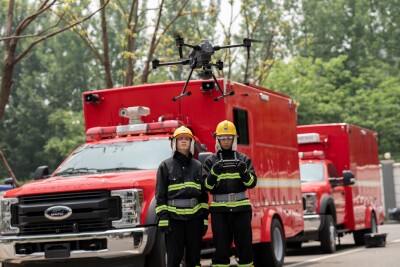
Public safety and emergency response. The thermal imager and laser rangefinder are intended to help locate heat sources and hidden targets during fire assessment and rescue. GDU’s video library includes firefighting assistance and emergency rescue demonstrations. The loudspeaker and spotlight attachments support communication and illumination at a scene.
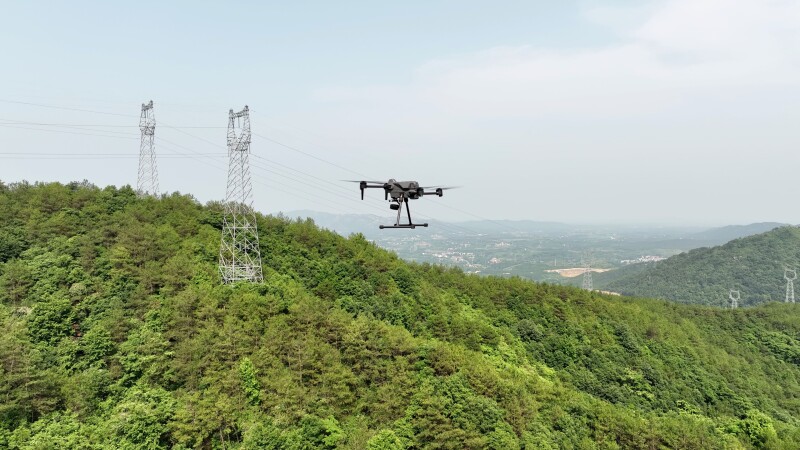
Infrastructure and water management. GDU’s video library also includes riverway inspection and power inspection demonstrations. The zoom range and rangefinder support detailed identification and precise positioning of targets.
Night operations. The near-infrared auxiliary light provides full-color night imaging that can support nighttime security assessment and evidence collection. The ANL01 navigation light flashes to mark the aircraft’s position during night flights.
GDU designed the K01 docking station for the S400E. The station includes a built-in air conditioner and an integrated electric control box with a UPS. It operates in wind and rain and stands by around the clock. A barrel-shaped cover rolls foreign objects off when it opens, which reduces the need for on-site maintenance. Operators control stations and aircraft through cloud service from a command center, so crews do not need to be at the launch site.
The S400E supports multiple route planning modes, automatic task dispatch, rapid charging, and continuous leapfrog missions for high-frequency work. UVER management software covers route planning, task management, data analysis, and report generation, with private or cloud deployment and cloud APIs for custom development. For field charging, the ABP01 case holds up to eight PD12 batteries and charges two at a time. GDU lists about 50 minutes to charge from 20 to 90 percent.
Where This Fits for Commercial Operators
For city program managers and service providers supporting several departments, the S400E consolidates multiple mission types into one platform. A single foldable airframe with swappable payloads can cover riverbank inspection, thermal assessment at fire scenes, and loudspeaker or spotlight work after dark, which reduces the number of aircraft a team needs to train on, maintain, and deploy. The backpack-portable design allows one operator to carry and launch the aircraft, and the K01 dock extends the same platform to unattended operation from a command center. Paired with UVER management software, agencies can handle route planning, task management, and reporting in one system. For organizations running frequent patrols or standardizing equipment across departments, that combination of payload flexibility and dock-based operation gives them a single platform to build a program around.








Comments